
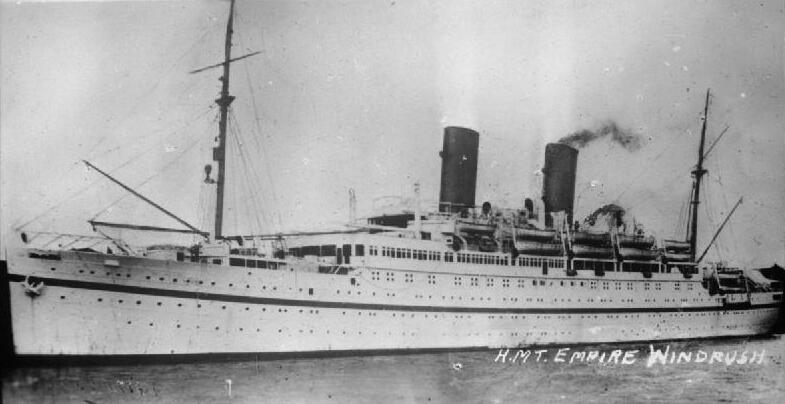
The arrival of HMT Empire Windrush into Tilbury docks on 22 June 1948 is now recognised as a key moment in the history of post-war Britain. Caribbean communities had settled in British cities and towns prior to the late 1940s, and indeed the Windrush was not the first vessel to make this journey bringing those who had fought in the Second World War back across the Atlantic to Britain following a period of leave after the conclusion of the conflict. Yet the disembarkation of the passengers from this ship has come retrospectively to represent the establishment of a permanent peace-time Caribbean population in the United Kingdom, rather than a temporary presence occasioned by the short-term circumstances of existential crisis. Seventy-five years later, ‘Windrush’ as a term represents not only an initial period of migration and interaction, but the entire Black British experience over the last seventy-five years, triumph and adversity, new relationships and old prejudices.[1]
One aspect of this story that has received relatively little attention is the religious experience of these migrants and their children. This is not entirely surprising, given that part of the overarching narrative of post-war Britain, along with migration from the New Commonwealth, was the triumph of secularisation and the apparent irrelevancy of organised religious faith in the experiences of most people.[2] Yet spiritual belief was key to how many Caribbean migrants viewed themselves, and the society they had settled in, whilst the responses of the British churches to the arrival of these new ‘strangers in a strange land’ (to paraphrase biblical scripture) gives important insights into the ambiguities of official and grassroots attitudes towards immigration from the 1950s to the 1970s.
Religious faith has always been an important part of migration and diasporic identity. It was the Protestantism of the Huguenots, fleeing persecution in France in the seventeenth and eighteenth centuries (and from whom the term ‘refugee’ originally derives) that guaranteed a positive reception in Britain.[3] In the nineteenth century Irish migration to Britain had profoundly changed the character of the Catholic Church, and Jewish migration from Eastern Europe at the turn of the twentieth century had had a similar effect on Orthodox Judaism in this country.[4] Movement from the Caribbean after the Second World War would ultimately play a similarly transformative role in British Christianity, although this was not yet clear in the period being discussed in this blog.
Caribbean migrants brought religious traditions with them as they journeyed to Britain. Most of these men and women had been part of Anglican or Catholic denominations on the islands, and it seemed natural, on arrival, that they would join the congregations of these church institutions in Britain. It became apparent very quickly, however, that this would not be as straightforward a process as the migrants had initially assumed. Although these religious affiliations might have the same labels as their counterparts in the Caribbean, in practice the day-to-day nature of worship was often radically different. More importantly than divergences in preaching or song was an often-unwelcoming initial response from existing church communities towards their new neighbours, and a hierarchical attitude that, although not always prejudiced, often assumed that the migrants were only in Britain temporarily, and thus that full inclusion and recognition within the local church structure were not necessary.[5]
But such a cold reception did not lead to the migrants abandoning their religious faith. In much the same circumstances as in which Methodism was born in Britain in the eighteenth century, Caribbean Christians responded to implicit exclusion from the Church of England by forming their own grassroots independent churches. There had been Black pastors and churches with largely African or Caribbean congregations in Britain before the First World War, such as the Sumner Road Chapel in Peckham, established by the Ghanian schoolteacher Thomas Kawa Brem-Wilson in 1906, but the movement of worshippers from the Caribbean away from formal Anglicanism and towards autonomous Protestantism, especially the Pentecostal Church, from the 1960s onwards was more demographically significant than anything that had taken place before.[6] As I discussed above, this was markedly counter to the general trend towards the marginalisation of organised Christianity, and by the early 1980s, when many clerics from within Church of England were publicly bemoaning the apparent irrelevance of their faith and the irreverence of their society, the ‘Black-led’ churches, as they became known, seemed to be the exception to this phenomenon.[7]
The existing British church establishments, Anglican, Free Church, and Catholic were slow to respond to the presence of large numbers of Black Christians in their neighbourhoods, and unsure what forms ministry to these communities should take. Given the large numbers of experienced pastors, priests and clerics who formed part of the Caribbean and West African diasporas in Britain, the most obvious course of action would be to make use of the talents of these men and women and install them in existing churches. But this process was uncertain, and met with resistance from some white congregations. In 1955 there was an attempt to appoint Dr Marcus James, a cleric from Jamaica who had previously ministered to Black students in London, as diocesan chaplain in Birmingham, which was ultimately abandoned, apparently because accommodation could not be found.[8] Similar difficulties were encountered in Manchester, where the local Baptist Union in 1962 appointed the Rev. C.S Reid, also from Jamaica, to coordinate religious provision on Moss Side; Reid would eventually return to the Caribbean after three years in the role.[9] One early suggestion from within the Church of England on ministry in Black communities was to appoint white missionaries who had returned from decolonised African nations; the inappropriate nature of this on multiple levels led to this scheme being quickly abandoned.[10]
Ultimately, whilst some Black Christians stayed in the Anglican and Catholic churches, many left and joined or formed Free Churches. Nevertheless, the Church of England hierarchy had by the end of the 1960s largely thrown themselves behind campaigns against legal discrimination and political racism. Michael Ramsey, the Archbishop of Canterbury, publicly opposed the 1962 and 1968 Commonwealth Immigrants Acts. Church leaders across the spectrum, including Anglicans, Catholics, and Quakers, spoke out against Enoch Powell’s ‘Rivers of Blood’ speech from April 1968, and the activities of the neo-fascist National Front in the 1970s.[11] During Christmas 1981, and following the civil unrest across British cities in the summer of that year that had led to an outpouring of renewed racist discourse concerning the ‘place’ of Black people in Britain, Robert Runcie, by this point the leader of the Church of England, predicted that one day a Black Archbishop of Canterbury would be appointed.[12] Sympathy for the Caribbean experience from the established churches by this point was apparent, but ultimately the Windrush generation, and their children, forged their own spiritual path in post-war Britain.
[1] See Kennetta Hammond Perry, London is the Place for Me: Black Britons, Citizenship and the Politics of Race (Oxford: Oxford University Press) 2015.
[2] See Callum G. Brown, Religion and Society in Twentieth-Century Britain (Harlow: Pearson Education Limited) 2006.
[3] Tony Kushner, The Battle of Britishness: Migrant Journeys, 1685 to the Present (Manchester: Manchester University Press) 2012, chapter three.
[4] Sheridan Gilley, ‘Roman Catholicism and the Irish in England’ in Donald M. MacRaild, The Great Famine and Beyond: Irish Migrants in Britain in the Nineteenth and Twentieth Centuries (Dublin: Irish Academic Press) 2000, Geoffrey Alderman, Modern British Jewry (Oxford: Oxford University Press) 1992.
[5] Interview with Pastor Ira Brooks in John Wolffe (ed.), The Growth of Religious Diversity: Britain from 1945 (London: Hodder and Stoughton) 1993, pp.116-119.
[6] Nicole Rodriguez Toulis, Believing Identity: Pentecostalism and the Mediation of Jamaican Ethnicity and Gender in England (Oxford: Berg) 1997, chapter two.
[7] David Holloway, A Nation Under God (Eastbourne: Kingsway) 1987, pp.36-37.
[8] Manchester Guardian, 14 September 1955.
[9] Manchester Guardian, 16 January 1962, The Guardian, 30 December 1964.
[10] The Times, 15 January 1959.
[11] Matthew Grimley, ‘The Church of England, Race and Multiculturalism, 1962-2012’ in Jane Garnett and Alana Harris (eds.) Rescripting Religion in the City: Migration and Religious Identity in the Modern Metropolis (Abingdon: Routledge) 2018.
[12] Liverpool Echo, 24 December 1981.
Dr Dan Renshaw is a Lecturer in Modern History at the University of Reading, specialising in migration, diaspora and identity in Britain and Europe.
All comments and opinions presented in this article are that of the author.
We have made every effort to abide by UK copyright law but in the instance of any mislabelling of images, please contact the author of the blog post

 READING HISTORY
You must be logged in to post a comment.