When I began to teach a module on the history of piracy in 2017, I shamelessly called it ‘Pirates of the Caribbean’ to piggyback on the global film franchise, though with the subtitle ‘Empire, Slavery, and Society, 1550-1750’ to show that it is still Serious History. I imagined that tapping into contemporary culture would make the course more appealing to students.
I was aghast to discover that the first film was then already fourteen years old – I was nowhere near as contemporary as I liked to think. In fact, I remember watching the first film in the cinema as a teenager when it came out. Luckily for me the franchise continued through the intervening years, and it’s still popular enough to make sense as a cultural reference.
The title of the module is more than just a recruiting hook, though, because one of the questions posed in our lessons is why a specific historical moment has come to define the idea of piracy so completely. If you think about the word ‘pirate’, the image that comes to mind is almost certainly a figure with a frock-coat, eye-patch, peg-leg, hook, black hat or red bandana, and parrot. Some of those elements have their basis in real historical individuals from the sixteenth to eighteenth centuries (like the 1550s French pirate François le Clerc, known as Jambe de Bois or wooden-leg), but others are pure invention.
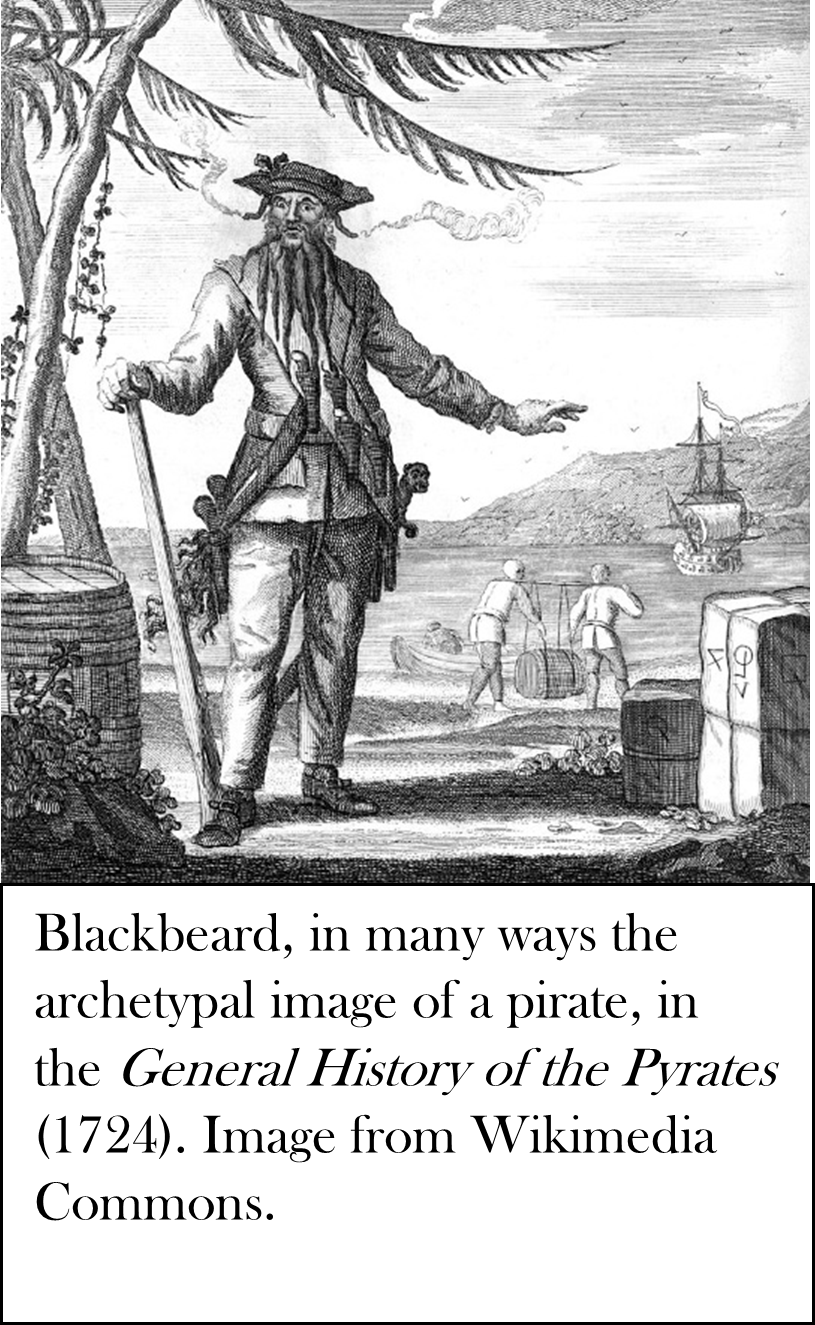
One explanation can be found in the period itself, when for the first time there was considerable ‘media coverage’ of piracy, such as Alexandre Exquemelin’s De Americansche Zeerovers of 1678(you can find some original illustrations here and an English translation here), or the notorious General History of the Pyrates of 1724 (you can find volumes one and two on Project Gutenberg; the author is listed there as Daniel Defoe, but this is a topic of debate).
Another reason, though, is the development of a self-sustaining genre of pirate media in fiction and films, and more recently toys and computer games. Robert Louis Stevenson’s Treasure Island (1883) was the first huge success and is now the most often retold pirate story. Even though it is entirely fictional, Stevenson was inspired by reading the General History. J. M. Barry’s Peter Pan appeared on stage in 1904 and was published in 1911 – and it’s still going, with a CBeebies musical version in 2014. Rafael Sabatini’s novels, like The Sea Hawk and the Captain Blood series, appeared over the next couple of decades. Like Stevenson, Sabatini drew on real historical characters, while in Peter Pan the pirates appear as a mix of threatening villains and bumbling, ridiculous fools.
It is with cinema, though, that the image of pirates has really thrived. There have been films about pirates released in every decade since 1908 (at least fifteen of them versions of Treasure Island, with another five TV adaptations of that book). The real heyday of pirate films came during Hollywood’s own ‘golden age’ in the middle of the twentieth century, with spectacular blockbusters like Captain Blood (1935), The Sea Hawk (1940), The Spanish Main (1945), Anne of the Indies (1951), Against All Flags, Blackbeard the Pirate, and The Crimson Pirate (all 1952). More pirate films continued in the later twentieth century, though veering away from the classic pirate film and more into comedy or science fiction: Hook(1991), Muppet’s Treasure Island(1996), and Treasure Planet(2002) were all aimed at younger audiences. Overwhelmingly, these films replicated that same image of pirates.
With the Pirates of the Caribbean: Black Pearl in 2003, Disney deliberately emulated the style of the mid-twentieth century swashbucklers. Indeed, some scenes in that film follow the older films very closely (captive damsels are given fancy dresses to wear in both The Spanish Main and Black Pearl, for example). Subsequent installations of the franchise have drifted more into epic seafaring fantasy, while new TV series like Black Sails and Our Flag Means Death have also taken different directions, but the same characters and tropes around piracy persist.
This media tells us more about the societies that produced them than it does about the history of pirates – except that in the seventeenth and eighteenth centuries, too, ideas about piracy were often a way to talk about other issues, like law, empire, race, and gender. It’s instructive, for example, to contrast the classic mid-twentieth-century swashbucklers with the twenty-first century Pirates of the Caribbean.
As Michael High has written, pirate films rarely show pirates carrying out acts of piracy. Instead, the classic swashbucklers of the 1940s-50s often had plucky, democratic heroes (usually Dutch and English ones) standing up to tyrants (usually Spanish ones), and usually the ‘pirate’ heroes were really government agents or eventually redeemed themselves and reconciled with the imperial authorities. In Pirates of the Caribbean, by contrast, both those authorities and the pirates are morally ambiguous, and over the course of the initial trilogy it is the greedy and brutal East India Company, with their tagline ‘It’s just business’, who emerge as the real villains. Without wishing to equate Disney with the EIC, there is a certain irony in their presenting a wealthy multinational corporation as the evil antagonist.
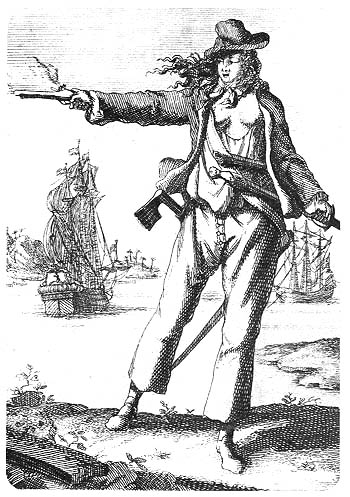
If the representation of imperial politics has changed between these pirate films, the representation of gender politics has… not. In Anne of the Indies and Against All Flags, Anne Bonny, fictionalised from the real-life pirate, is a fierce, unconstrained figure; but in Anne of the Indies she ultimately gives her life to save the object of her affections – and his much more conventional wife – from Blackbeard. Similarly, though Elizabeth Swann begins Black Pearl as a proto-feminist raging against the constraints of corsets, she ends the first trilogy as a wife and mother patiently awaiting her husband’s return from sea. Contrast that with Angelica in On Stranger Tides, another take on Anny Bonny: a freewheeling, cross-dressing imposter who is eventually punished for her promiscuity when Jack Sparrow maroons her at the end of the film. The scene where Sparrow discovers Angelica’s identity by kissing her and revealing her cleavage is something straight out of the pages of the General History (which will itself be 200 years old next May).
Bonny has continued to evolve as a fictional character in Black Sails, where she is a cold and calculating individual, whose fortunes rise and fall time and time again. Two recent dramatic podcasts have also featured Bonny and her companion Mary Read, Hell Cats, and The Ballad of Anne & Mary, testifying to their continued appeal, not least due to speculation about their sexuality. Our Flag Means Death only briefly alluded to the piratical pair, but fans hope to see them appearing in an upcoming series.
Whatever they tell us about contemporary society, these films have placed the history of piracy front and centre. In fact, there has been a marked rise in scholarship on this subject in the last two decades, and I have to wonder how much credit for that should be given to these films, and their impact on impressionable young minds (like mine, twenty years ago) who later became historians. Clips from the films also make for good teaching material. I was surprised how often a soundbite can relate neatly to some debate within scholarship. Are pirates really after ‘freedom’, as Jack Sparrow, and some historians, would say? Was there any such thing as a ‘professional pirate’, as Tim Curry sings in Muppet Treasure Island?
If you want to know more, of course, you’ll have to come and study with us in Reading. Anchors aweigh! Make way for Tortuga!
Further reading: you can find the reading list for Pirates of the Caribbean: Empire, Slavery, and Society, 1550-1750 here. I would like to thank PhD student Luke Walters for contributing his knowledge of more recent TV shows (particularly Black Sails and Our Flag Means Death) to this post. Read more from Luke in his Pirate Legends series for the Reading History blog.
Dr Richard Blakemore is an Associate Professor at the University of Reading, specialising in early modern social & maritime history.
All comments and opinions presented in this article are that of the author.
We have made every effort to abide by UK copyright law but in the instance of any mislabelling of images, please contact the author of the blog post

 READING HISTORY
One response to “Dead Men Film No Reels: A Short History of Pirate Films, by Dr Richard Blakemore”
[…] I wrote in a previous post, as well as learning about the history of piracy in this module, we also think about why this one […]