It has been said that “dead men tell no tales”, though if one looks at the wider history of the so-called Golden Age of Piracy and how it has affected our perception of maritime predation, this is evidently not the case. For over a hundred years, studios have produced dozens of swashbucklers, and it is quite humorous that the Golden Age of Piracy was a vital component of the Golden Age of Hollywood. Partially commencing with such titles as Captain Blood (1935) and Against All Flags (1952), until the 1990s, pirates remained a prominent component of the film industry. Although the genre suffered a blow with the failure of Cutthroat Island (1995), with the commencement of the Pirates of the Caribbean franchise in 2003, the genre experienced a second golden age. In turn, videogaming too embraced this renewed interest in piracy, and so in this entry, we will investigate how the POTC franchise has altered the way in which game studios treated its pirates.

Prior to the introduction of Captain Jack Sparrow, the early videogame pirates reigned supreme. From the 1980s onwards, as the gaming industry experienced its own golden age, piracy began its slow decline in the film industry, though this did not deter developers from creating their own pirate heroes. Notwithstanding, there is an inconceivable number of titles relating to piracy, from the adventures of Sir Arthur Pendragon in Blackwyche and a videogame adaptation of The Goonies (both 1985), piracy emerged as an extremely lucrative genre. The year 1990 however experienced what many fans perceive to be the quintessential early pirate title- The Secret of Monkey Island. Innovative in gameplay and revolutionary in its design, Monkey Island was a point-and-click mystery adventure in which you play as wannabe-pirate Guybrush Threepwood, against undead buccaneer LeChuck and his ghostly retinue. Perceived as one of the greatest videogames of all time, Monkey Island spawned a series of sequels and spin-offs, including its latest title- Return to Monkey Island, released in 2022. Rather than a dashing hero with an unshakable wit, you play as quite the opposite. Guybrush is a suave and lacklustre young pirate, prone to clumsiness and often wins the day by complete accident, much like Jack Sparrow himself.
As technology progressed into the early twentieth century, so too did videogaming, and the days of Monkey Island slowly began to sail beyond the horizon. New gameplay mechanics and genres began to take a foothold in the gaming world, yet the days of piracy was not quite over yet. In point of fact, the best was arguably yet to come. Pirates began to be perceived as a somewhat untested genre for the next generation of gaming, yet by the end of the first decade, the tide was beginning to turn. Two pirate-based titles for announced for release in 2011- Pirates of the Caribbean: Armanda of the Damned was a planned open-world adventure game set in the same continuity as the films, developed by Propaganda Games. Playing as Captain James Stirling, you piloted the Nemesis, a legendary vessel akin to the Black Pearl. Partially inspired by traditional RPGs, the player could customise many of Stirling’s characteristics, subservient to two playstyles: the honourable Legendary, and the piratical Dreaded. Playing on both land and engaging in naval combat, it was the objective of the player to complete the Nemesis by uncovering all of the ship’s missing pieces and earning a legend to rival that of Jack Sparrow himself.
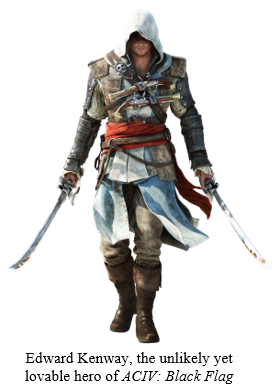
Despite a heavy marketing campaign and legions of dedicated fans, it was sadly not to be. In 2010, the project was cancelled, and Propaganda Games was closed a year later by the Walt Disney Company despite the game reportedly nearing the final stages of development. Despite this, the second title- Risen 2: Dark Waters was later released in 2012 to a lukewarm reception, despite the game’s intriguing voodoo-inspired take on the Golden Age of Piracy. It seemed that the piracy genre continued to flounder, though fans only had to wait a year for what is now perceived as one of the greatest videogames of all time. 2013 saw the release of Assassin’s Creed IV: Black Flag, incontestably one of the most influential titles of the 2010s. Believed to have been partially inspired by the gameplay mechanics first shown in Armanda of the Damned, Ubisoft’s ground-breaking title is now perceived to be the quintessential pirate videogame. You play the role of Edward Kenway, a native Welshman and tyro pirate captain, yet unlike previous Assassin’s Creed heroes, Kenway is arrogant, has a thirst for drinking, and is something of a loose cannon. Set in an alternative version of own history, aboard your ship- the Jackdaw, you may cruise the open-world of the Caribbean Sea, seizing English and Spanish merchant ships, all the while encountering several real-world pirates, including Calico Jack, Anne Bonny, and Blackbeard. Black Flag’s design was evidently inspired by the adventures of Jack Sparrow, and there is even an option for the player to customise the Jackdaw to be reminiscent of the Black Pearl.

Our last port of call on this voyage takes us to the shores of one of the most successful multiplayer titles in videogame history. In 2018, Sea of Thieves was released, a shared open-world pirate adventure game in which you and several friends may take to the ocean in search of plunder and glory. You may take up arms in the sloop as a dastardly duo, or if you’d rather take a brigantine or galleon for a spin, you can team up in a three or four-person crew. Heavily inspired by Pirates of the Caribbean, you can encounter vicious skeleton captains hoarding chests of gold, be attacked at any time by the kraken, yet the real danger are other players. Though from the game’s release it was evident that POTC played a heavy role in the development cycle, 2021 saw an unexpected yet very welcome surprise. The A Pirates’ Life expansion brought Jack Sparrow himself to the Sea of Thieves, thus placing the game’s events within the continuity of the films. This was the first in a series of updates for Sea of Thieves, as just last month, the Monkey Island expansion was also released, so for the very first time, fans of the world’s largest pirate fanbases may interact with both Jack Sparrow, and Guybrush Threepwood.
The world of videogame pirates deserves a scholarly work of its own. From smaller titles such as Sea Dogs (2000) and Pirates of the Caribbean Online (2007-2013) to titans such as Assassin’s Creed and Sea of Thieves, pirates have experienced a new golden age in the world of console and controller, and Pirates of the Caribbean evidently paved the way.
Luke Walters is a PhD Student at the University of Reading, specialising in Early Modern piracy and privateering.
All comments and opinions presented in this article are that of the author.
We have made every effort to abide by UK copyright law but in the instance of any mislabelling of images, please contact the author of the blog post

 READING HISTORY
You must be logged in to post a comment.