
Despite the countless interpretations of the pirate ship, from Captain Kidd’s Adventure Galley to Captain Hook’s Jolly Roger, it has above all else been characterised as a theatrical stage. Images of dashing rogues rejoicing on deck swearing and drinking, all while the captain and his officers plot their next heist in lavishly decorated cabins. While this does paint a fantastical and idealistic picture of the pirates’ life that certainly still entices, this is unfortunately a far cry from reality. Despite would Hollywood swashbucklers would have you believe, pirates did not traditionally operate large, three-mated vessels, but primarily relied on smaller shallow-drafted crafts, albeit with a few notable exceptions, which we will discuss in this entry, along with a detailed history of Captain Jack Sparrow’s beloved Black Pearl.

During the early eighteenth century, due to the continued harassment of British trade by the French guerre de course and the Spanish guardacostas privateering forces, there arose the demand for swift, manoeuvrable vessels. The result of this was the Bermudan sloop, with its ranked mast, shallow draft and a bowsprit that could as long as the vessel itself, the sloop was built for speed, and was ideal for both merchants and pirates alike. Pirates preferred these classes, and regularly careened them (this being the scrapping of barnacles and other sea life that would attach themselves to a ship’s hull) to ensure speed. As Charles Johnson himself, the ideal pirate ship represented a “light pair of heels being of great use either to take, or escape being taken”, and the sloop perfectly personified this statement.Indeed, one such instance of the sloop’s usefulness can be spied in the case of the pirates Edward Low and Francis Spriggs. While being pursued by the HMS Mermaid in Feburary 1723, the pirates managed to outmanoeuvre the hunting vessel which ran around on a shoal while attempting to continue the chase in shallower waters, resulting in one of the ship’s masts collapsing in the process. Blackbeard is known to have commanded at least two sloops during his piratical career, these being the Revenge, commandeered from Stede Bonnet, and the Adventure, which was ‘appropriated’ from Spanish merchants in 1718.
Yet, pirates did not always favour smaller vessels. Take into consideration Blackbeard’s Queen Anne’s Revenge. As with many pirate vessels, the ship that would become the terror of the Caribbean passed hands a number of times. Previously La Concorde, it was constructed in Nantes along the River Loire between 1709 and 1710, and was originally built to be privateering naval frigate, albeit on a smaller scale, by the time of its capture, it was repurposed as a slaving vessel and was under the command of Captain Pierre Dosset. On 28 November 1717, some sixty miles off the coast of Martinique, Blackbeard took command of the vessel and made it his new flagship. Blackbeard rechristened it in honour of the late Queen Anne, the last monarch of the Stuart dynasty, a testament to his believed Jacobite political beliefs, displaying his own admiration for the former queen and resentment towards the House of Hanover.

Blackbeard outfitted his flagship with over forty guns, thus rendering it a veritable floating fortress. Despite this, he only sailed it for less than a year. Piloting the Revenge, Blackbeard harassed several ships from Boston in retaliation for the poor treatment of Sam Bellamy’s crew, and the notorious HMS Scarborough. In May 1718, Blackbeard ambitiously blockaded the port of Charleston, and used the Revenge’s intimidating presence to stop and search all vessels entering or leaving the harbour. It remains a mystery whether it was Blackbeard’s intention or a miscalculation on the captain’s part, but he ran the Queen Anne’s Revenge off a sandbar at Topsail Inlet, North Carolina. Blackbeard loaded the sloop Adventure with his supplies and treasures and marooned many of the crew on the island, yet these fortune pirates were later rescued by Blackbeard’s former sidekick Stede Bonnet. For now, and the rest of time, the legendary pirate fortress will remain at the bottom of the inlet, slowly corroding away until it disappears completely. The Queen Anne’s Revenge appeared in On Stranger Tides, the fourth instalment of the franchise, though it was heavily modified in favour of a much sinister aesthetic. Drenched in torn crimson sails, blackened skulls and a vicious grinning flag, it was devised as an antithesis to the Black Pearl, who in contrast represented the heroic aspects of piracy.
“You’ve seen a ship with black sails, that’s crewed by the damned, and captained by a man so evil that Hell itself spat him back out?” -Mullroy
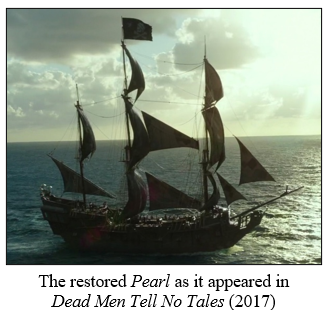
Much like its captain, for well over two decades, the Black Pearl has dominated the popular perception of pirates. From a logistical perspective, the Pearl is a hybrid vessel, being an amalgamation of a galleon and an East Indiaman, a standard ship of the various East Indian companies. According to the franchises’ lore, the ship that would become the Black Pearl began its career as the Wicked Wench, under the command of an unnamed pirate captain. After defeating Spanish pirate hunter Armando Salazar with one of his infamous tricks during a climactic battle at the Devil’s Triangle, a young Sparrow was elected captain by the remainder of the crew. For unspecified reasons, Sparrow abandoned piracy and earned a commission with the East India Trading Company, spearheaded by overarching antagonist Lord Cutler Beckett. After Sparrow bungled a job to the west coast of Africa, Beckett labelled Sparrow a pirate, bestowing him his infamous ‘P’ brand later acknowledged by James Norrington in the opening of Curse of the Black Pearl. Beckett ordered the vessel burned at its moorings, and desperate to save his beloved ship, with his final breath and in a final act of desperation, Sparrow called upon Davy Jones. Striking a deal with the devil, in exchange for thirteen years as captain, Sparrow promised an eternity of servitude aboard Jones’s Flying Dutchman after his time came to an end. Being raised from the depths with a burned hull and scorched sails, Sparrow rechristened the Black Pearl, setting a course for the pirate haven of Tortuga. After suffering a mutiny a few years later at the hands of his rival Hector Barbossa, the crew and the ship itself became cursed by Aztec gold, thus setting in motion the plot of the suitably titled Curse of the Black Pearl. Armed with thirty-two guns and bearing the appearance of a ghost ship, the Black Pearl, albeit entirely fictional, is now the most famous pirate ship of all time.
Historians Marcus Rediker and Peter Linebaugh once described the pirate ship as a ‘world turn upside down’, in reference to the pirates’ defying of the cultural and social normalities of their age. While this idea remains debated, whenever I think of the best way to describe a pirate ship, I always return to Sparrow’s speech to Elizabeth Swann at Rum Runner isle in the final act of Curse of the Black Pearl:
Wherever we want to go, we’ll go. That’s what a ship is, you know. It’s not just a keel and a hull and a deck and sails, that’s what a ship needs but what a ship is…
what the Black Pearl really is… is freedom.
-Captain Jack Sparrow
Further Reading:
Crispin, Anne. Pirates of the Caribbean: The Price of Freedom. 2011.
Cordingly, David. Under the Black Flag. New York, 2016.
Johnson, Charles. A General History of the Robberies and Murders of the Most Notorious Pirates (1724), edited by Johan Franzén. Turku, 2017.
Kaplan, Arie. Swashbuckling Scoundrels. Minneapolis, 2016.
Lee, Robert. Blackbeard the Pirate. Winston-Salem, 2004.
Little, Benerson. The Sea Rover’s Practice. Potomac, 2005.
Rediker, Marcus and Linebaugh, Peter. The Many-Headed Hydra. London, 2012.
Rediker, Marcus. Villains of All Nations. Croydon, 2012.
Rennie, Neil. Treasure Neverland. Oxford, 2013.
Luke Walters is a PhD Student at the University of Reading, specialising in Early Modern piracy and privateering.
All comments and opinions presented in this article are that of the author.
We have made every effort to abide by UK copyright law but in the instance of any mislabelling of images, please contact the author of the blog post

 READING HISTORY
One response to “Pirate Legends Resurfaced: The Black Pearl and Real Pirate Ships, by Luke Walters”
[…] Walters,L.(2023, July 31).Pirate Legends Resurfaced: The Black Pearl and Real Pirate Ships.Reading History.https://unireadinghistory.com/2023/07/31/pirate-legends-resurfaced-the-black-pearl-and-real-pirate-s… […]