We have been sharing some piratical material on this blog recently, to mark the twentieth anniversary of the first Pirates of the Caribbean film in 2003, much of it related in some way or another to an undergraduate module that I teach here at Reading, also called ‘Pirates of the Caribbean’ (I would claim this is a truly astonishing coincidence but, well, it isn’t).
As I wrote in a previous post, as well as learning about the history of piracy in this module, we also think about why this one particular period in history has come to dominate popular imagination on this subject. I had already tried out alternative assessments in other modules, to offer students a chance to practice skills besides those more traditionally associated with undergraduate essays, and this module seemed the perfect place to introduce a creative assessment portfolio. Students could either produce a series of smaller pieces, or a single design with an accompanying discussion of the research that went into it. They could make anything they liked, so long as it related to the history of piracy and used suitable evidence to develop the design. I also asked students to think about issues like audience and format: what key ideas did they want to communicate about the history of piracy, and how could they use the format to do that for their chosen audience?
The students on the module submitted an impressive range in their portfolios. It was particularly reassuring to see how students took the portfolio in directions that matched their own interests or ambitions: film concepts, boardgames (and drinking games – complete with a non-alcoholic version), and learning resources or lesson plans all featured. We only have space to share a few examples here, and we would especially like to thank the four students featured for their permission to share their work.
Neriece Bridgeman – Grace O’Malley
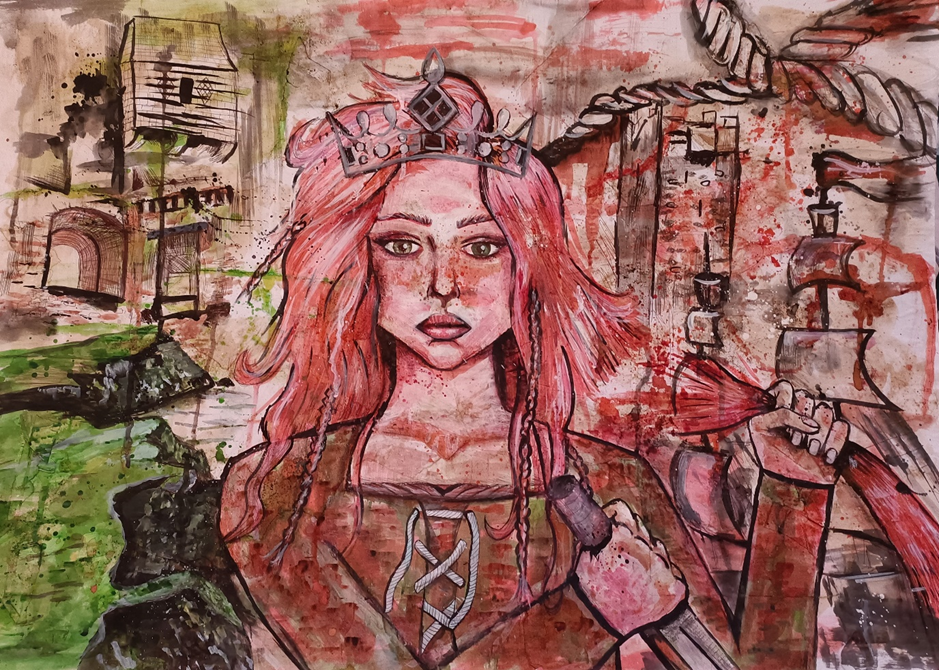
Neriece painted this gripping portrait of Grace O’Malley (the English version of her name; in Irish, it’s Gráinne Ní Mháille), focusing on the story that she defiantly cut her hair after her father refused to let her join him on a sea voyage. It is apparently with this act that the nickname ‘Gráinne Mhaol’, or ‘bald Grace’, began. Neriece based her styling of Grace on the statue outside Westport House in County Mayo, and researched the landscape of Clare Island and the architecture of Belclare Castle and Kildavnet Castle, featuring in the background. The striking colour palette represents the links to her home in Ireland and her dramatic involvement in piracy. For more on Grace O’Malley/Gráinne Ní Mháille, see these blog posts (here and here) from Royal Museums Greenwich.
Sam Newman – Irish Rovers
Sam, who also happens to be a co-founder and president of the Sea Shanty and Folk Society at Reading University Student Union, produced a series of sea shanties for his portfolio. This one takes the melody of the popular folk song The Irish Rover and combines it with the work of John C. Appleby on piracy in Ireland to produce something new, while keeping some original lines from the song where they fit its new subject. Sam’s other songs told the story of Grace O’Malley/Gráinne Ní Mháille and Anne Bonny. In fact he produced two on Bonny, inspired by two different songs, John Paul Jonesand John Paul Jones is a Pirate. Just as those two songs explore different views on their subject, Sam’s versions show the different ways that Bonny’s life has been interpreted. This combination of scholarship, tradition, and innovation seems to me in the best style of folk music!
Rachel Hunt – The Archaeology of Piracy

Rachel is an Archaeology and History student and so brought her distinct interdisciplinary perspective to the study of piracy. In this webpage, Rachel explores some important studies in pirate archaeology, from the banks of the Thames to the sunken streets of Port Royal in Jamaica, much of which was destroyed by an earthquake. She touches on smugglers’ stairways and shipwrecks to think about what this material evidence can tell us about the lives of pirates. Not only is the website superbly researched, it also uses visual techniques to draw in the audience. How can you refuse the witty invitation ‘Scroll To Dig Deeper…’?
Oskar Leisinger – The Scurvy Podcast
Besides sitting on the committee of the History Society at Reading, Oskar is interested in pirate games, films, and television, and so he produced a podcast video splicing together footage that represents ‘pirate havens’. Oskar especially focuses on the depiction of uninhibited life in Tortuga in both Anne of the Indies (1951) and Pirates of the Caribbean: Curse of the Black Pearl (2003), and the way that different computer games use havens in distinctive ways (and for more on games check out this post by Ph.D. student Luke Walters, who also taught on the module). Oskar continues the podcast by comparing these imagined buccaneering hotspots with historical evidence such as A General History of the Pyrates or the writings of buccaneer Alexandre Exquemelin, and the analysis of scholars like Douglass Burgess, to evaluate the accuracy of the depictions. Watch out for the bear.
We are very grateful to all the students who agreed to have their work shared here.
Dr Richard Blakemore is an Associate Professor at the University of Reading, specialising in early modern social & maritime history.
All comments and opinions presented in this article are that of the author.
We have made every effort to abide by UK copyright law but in the instance of any mislabelling of images, please contact the author of the blog post

 READING HISTORY
You must be logged in to post a comment.