
Enjoy this guest post from our colleagues at the Mills Archive, who preserve records of milling history. This piece was authored by Nathanael Hodge – thanks to the archive for allowing us to share their work.
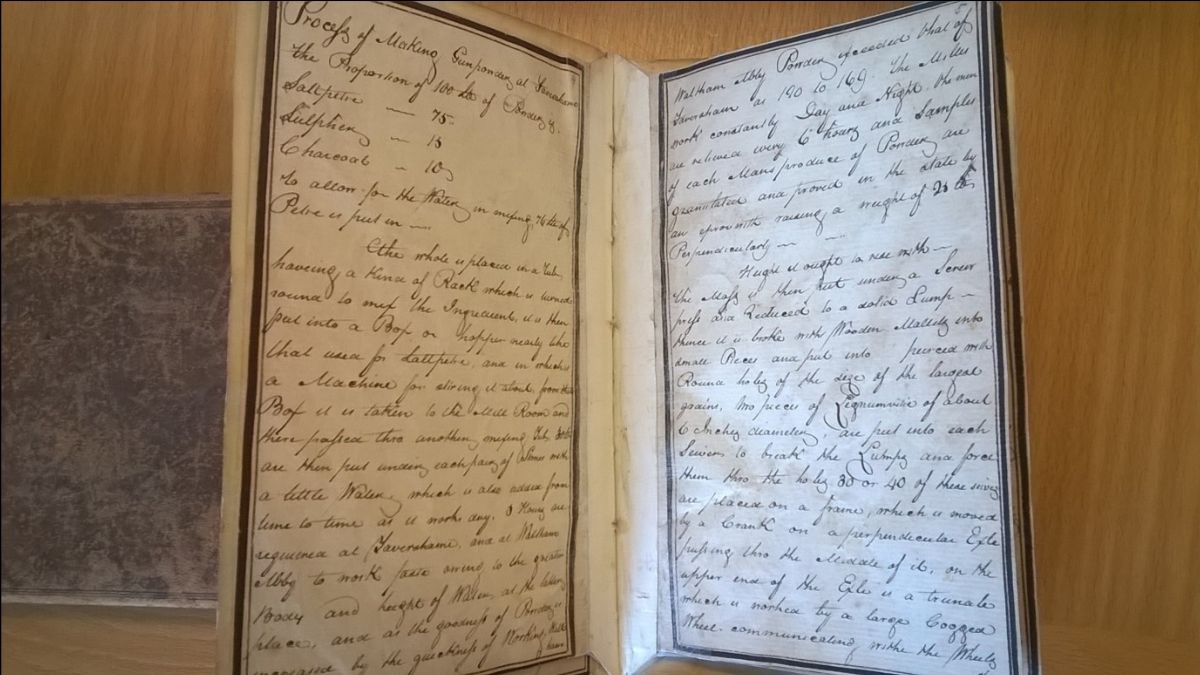
The image above shows a 1798 notebook recording the process of gunpowder manufacture, as carried out at the Royal Gunpowder Factory, Faversham.
Gunpowder, or black powder, is a mixture of saltpetre, charcoal and sulphur. Although medieval Europeans gave the devil the credit for its invention, it is believed to have originated in China and to have arrived in the west by the 13th century. At first made in small amounts in a pestle and mortar, from the 16th century there were water driven mills in England, and from 1589 these had to have a royal licence to operate, although some operated illegally.

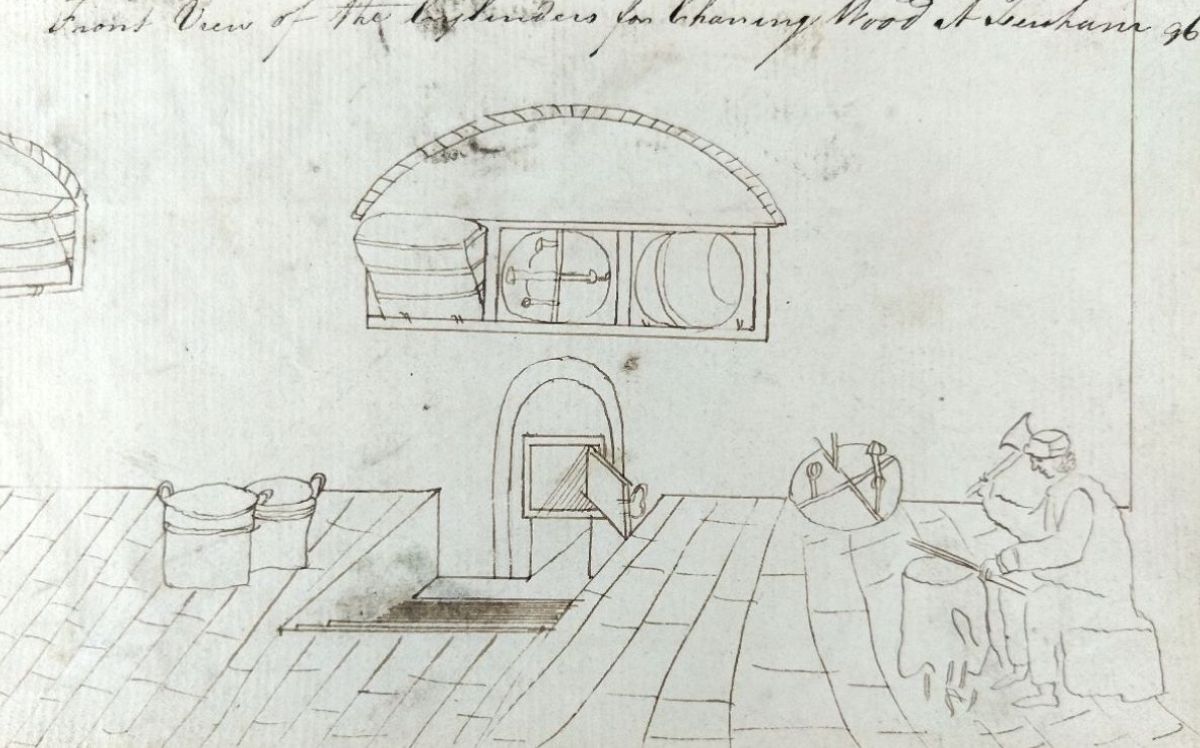
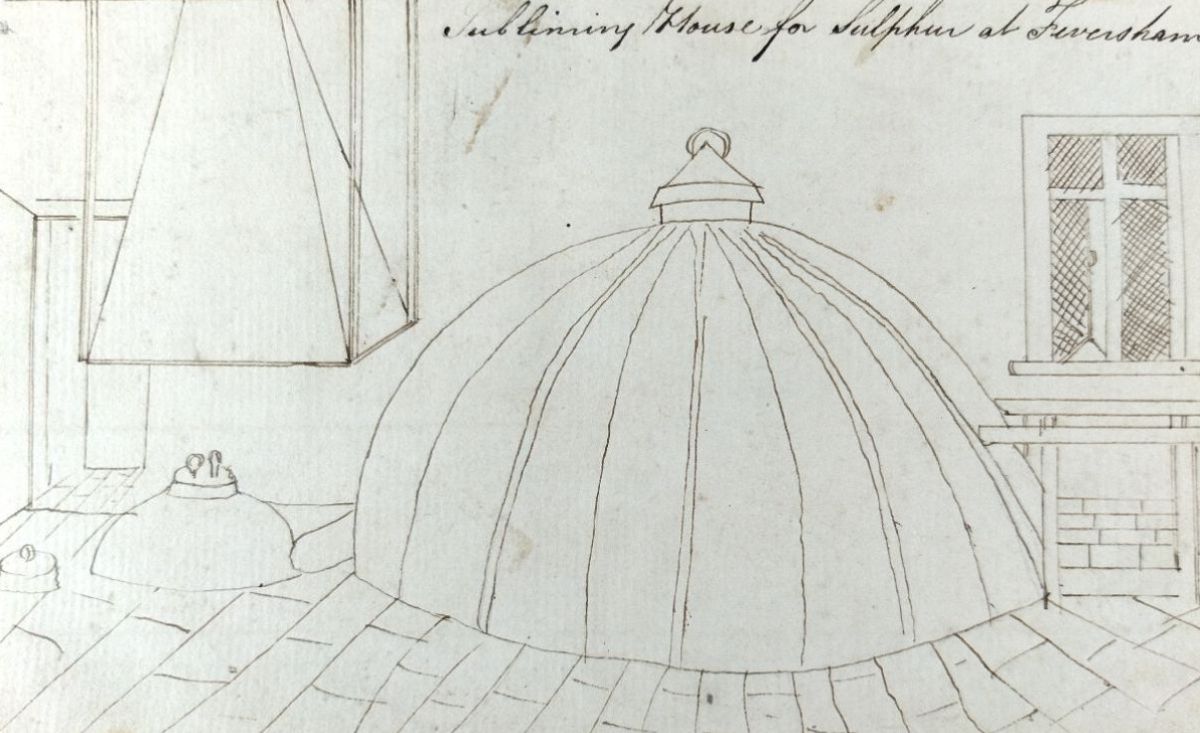
The first stage in the manufacture of black powder was the preparation of the ingredients. Saltpetre (potassium nitrate) could be manufactured from decomposed animal dung, mixed with lime. Sulphur was imported from Italy and Sicily, while charcoal was made by charring wood. Before being mixed together the ingredients had to be powdered and sieved and weighed to ensure the right quantities were used.

The next stage was incorporating. This was carried out using the edge runner stones shown in the image above. The notebook describes the process as follows:
Process of Making Gunpowder at Faversham
… The whole is placed in a Tub, having a Kind of Rack which is turned round to mix the Ingredients, it is then put into a Box or hopper … in which is a Machine for stiring it about, from that Box it is taken to the Mill Room and there passed thro another mixing Tub, 30 lb are then put under each pair of Stones with a little Water, which is also added from time to time as it works dry … The Mills work constantly Day and Night, the men are relieved every 6 hours …
The powder was pressed, and then placed in a corning machine in which it was passed through parchment sieves. It was then granulated and glazed with black lead to make the grains resistant to moisture, dried in heated stoves and packaged in oak barrels. These were manufactured on site, and coopers made up a large part of the workforce of a powder mill.


Accidents were common, especially in the incorporating mill. At Waltham Abbey in 1861, for example, the workmen failed to put a piece of leather under the edge runner stones when moving them and this lead to a spark which ignited the powder. Four men were badly burnt, one of whom died.
The whole notebook has been digitised and is available online.
More information on gunpowder manufacture from the Mills Archive:
Digitised notebook from Waltham Abbey
Other records in our archive
History of gunpowder manufacture
The devil’s art

 READING HISTORY
You must be logged in to post a comment.