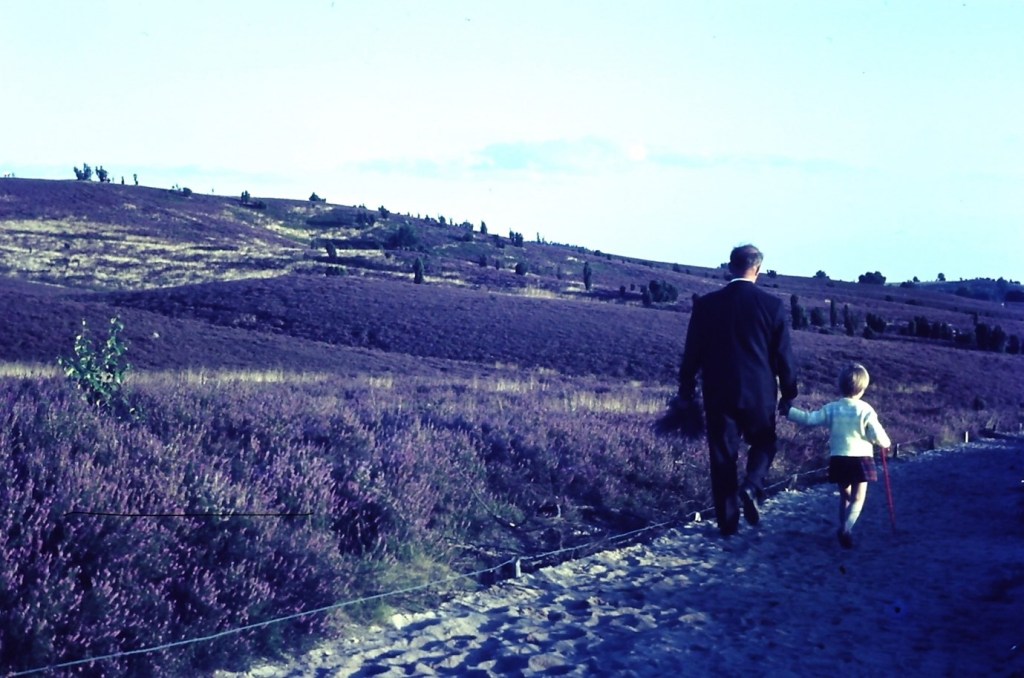
My father was not disabled. He was not without ability or limited. He was without sight, and he could not smell. A scar on his temple indicated where shrapnel had entered his head. He never wore dark glasses to hide that he had lost his eyes and wore beautiful, hand painted protheses. The very term disability would have made him furious.
In familiar environment people often did not notice his blindness, at least not initially. In old age, he tiled a roof. He made furniture. He often tinkered with repairing things. He worked until his regular retirement. But no doubt, his blindness did radically change his life. My parents had me late in life, and I grew up the daughter of a blind man.
First came the walking. My father taught me to walk and from an early age I became his guide. Often with my mother the three of us went to the countryside for hikes, or on holidays to the seaside in Denmark, the Eifel region in Germany, the Alpes. My father taught me to passionately love slides in playgrounds, he taught me to swim, he loved to go downhill on a grown ups’ sleigh with me when I was little – and he taught me to see. My father taught me not just to look but to see. Looking meant that I learned reading at a young age, because I was eager to read to him, and he entertained that. At times. Looking meant also being his sports commentator when he was watching television and he found the reporters wanting – yes, he always used the verb to watch. He insisted I learned to read maps before learning how to read, both at pre-primary school age to help my mother find her way when driving. But among all the enabling he gifted – and at times pressed upon me – most important was the seeing.
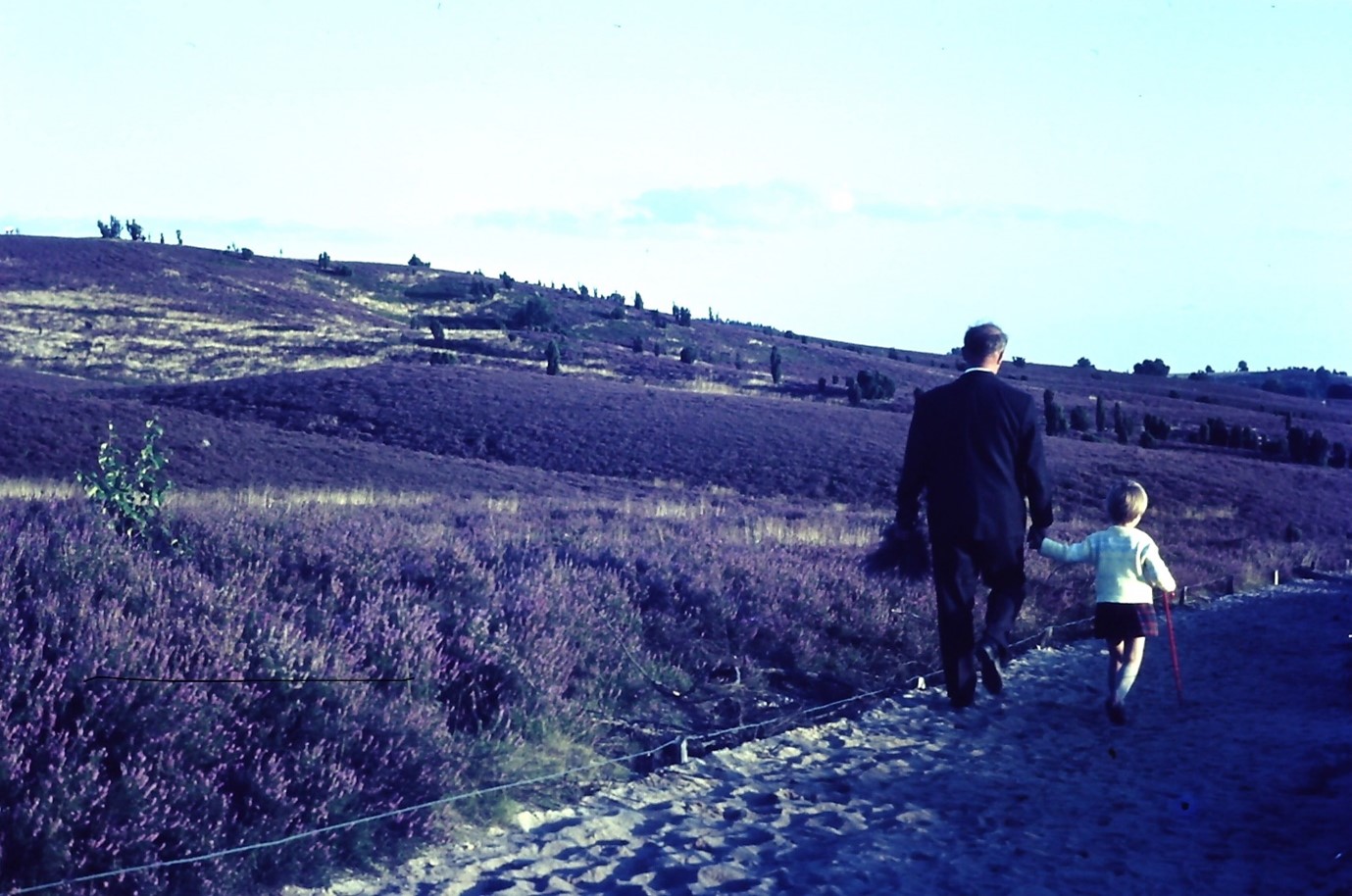
F.W.H.E. and Heike I. Schmidt hiking in the north German heath landscape Lüneburger Heide
My father was a painter –both an artisan and an artist – blinded at age twenty-six. He was deeply disappointed that I have no ability to produce art – but when he realised that I thrive on fine arts, architecture, and music at times we had thorough discussions which we both enjoyed. My connection with and research on landscape is much derived from him having gifted me the sense of wonder, the sublime, narrating landscape and more broadly lived experiences of the past – shaping my craft as a historian.
We shared the experience of seeing and not seeing together. One summer, at age fifteen I travelled with my parents and a friend through Finland, Norway, Denmark for a few weeks, with my mother driving. North of the polar circle I had a brief interlude of snow blindness which scared us all. My father became uncharacteristically quiet and morose. He said he was affected by the landscape which was just blue and green and grey. The ability to experience colour always remained with him.
The first time I lived in Africa, as a visiting student at the University of Zimbabwe, I stayed for thirteen months. My parents came to visit, and we toured the country. For my father it was an awakening. The tactility, the rediscovery of all his senses was transforming for him. He loved listening to giraffes and elephant grazing in national parks, rhino snorting. Despite the warm weather during the summer visit, we made a fire which stimulated my father to wiggle his toes close to it in pure joy at the sound of the crackling wood and the feeling on his skin. Being invited to hold an African friends’ toddler and asked to touch his skin and hair made him laugh out loud. Our seeing together changed as I for once could show my father a world he had known much longer than I had and yet this was new to him. My father looked his happiest I ever saw him.
Within months he was diagnosed with cancer and after a long period of suffering during which I suspended my degree and became his carer, he passed away. It never occurred to me that I had been his carer before just because he had no eyesight. We had a deeply conflictual father daughter relationship, but I am grateful that he taught me how to see – colour, landscape, the world. Somewhat ironically in his last hours the morphine gave him visions.
Public, political, and academic discourse about disability has more than ever shifted towards the need for understanding, accessibility, and allyship. However, more often than not – such as the very term ‘disability’ – this still comes hand in hand with notions of lack of ability; of being different, other; of pity and empathy – rather than compassion, the willingness to acknowledge somebody else’s lived experience, as who they are in this world, at eye-level. That means not looking down, or up, or sideways to the differently abled, but simply to connect.
Dr. Heike I. Schmidt is an Associate Professor in the Department of History at the University of Reading.
All comments and opinions presented in this article are that of the author.
We have made every effort to abide by UK copyright law but in the instance of any mislabelling of images, please contact the author of the blog post.

 READING HISTORY
You must be logged in to post a comment.