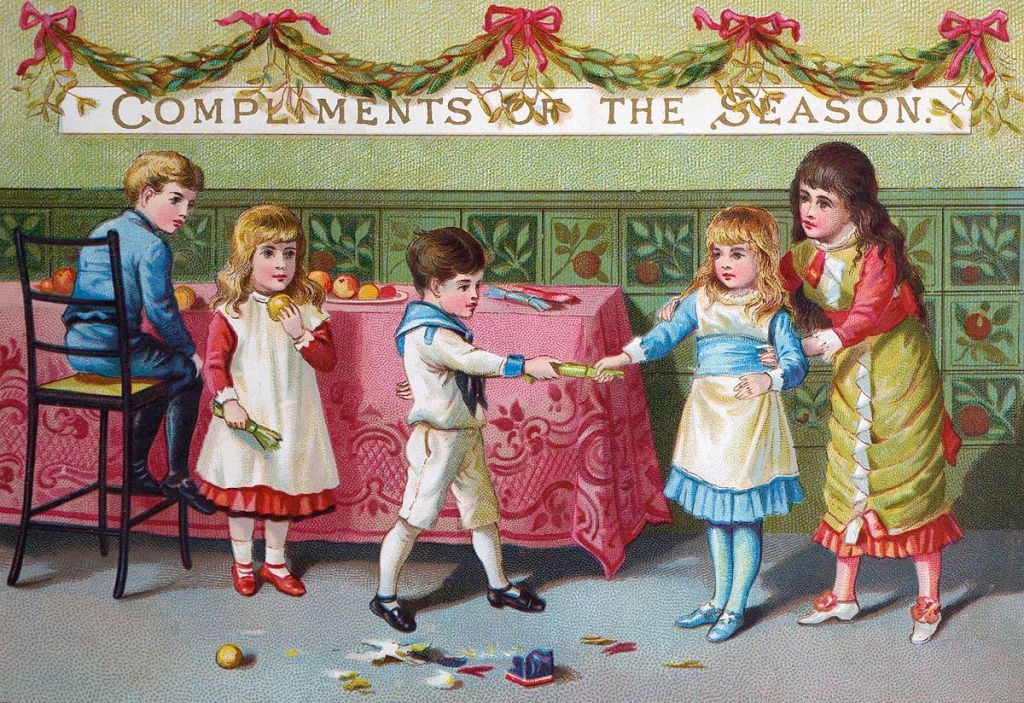
If you are stuck for gift ideas this Christmas, why not give a book? For as long as there have been books, books have been given as gifts.
The Roman poet Martial included ‘A Parchment Copy of Homer’ in his first century list of ‘Presents Made to Guests at Feasts’. But it took the nineteenth century, and its happy coincidence of commercial publishing, falling paper prices, and growing literacy, to make Christmas ‘the season of Book-blossoms’. As the New York Times put it in 1851: ‘The Holidays act upon books like April upon trees.’ Then, as now, books could be seen as a particularly personal gift – a well-chosen title demonstrating how well the giver understood the recipient – or just something that is easy to wrap (an important consideration for about half the population) and which can be purchased without much effort (provided one is happy to subsidise Jeff Bezos’s quest for eternal youth).
Since the early twentieth century, and the publication of the actress Sarah Bernhardt’s My Double Life (1907), the celebrity memoir has become a staple of the Christmas book-giving tradition. This year’s leading example, Britney Spears’s The Woman in Me, might endure and become a classic of its genre, or January might find many copies re-gifted to local Oxfam shops. ‘Who now reads Spencer?’, the twentieth century US sociologist Talcott Parsons asked of the nineteenth century English evolutionist Herbert Spencer. Parsons was referring to Spencer’s overlong and generally unreadable philosophical works, rather than his overlong and generally unreadable autobiography, but had he lived longer he might have posed the same question about Kerry Katona or Chantelle from Big Brother who, not so many years ago, reportedly received advances of £650,000 and £400,000 respectively for memoirs which no one now remembers.
The biggest selling memoir of 2023, and indeed the fast-selling non-fiction book of all time, Prince Harry’s Spare was unusual in not being aimed at the Christmas market – it was published in January – but it does contain a wonderful vignette about Christmas gift-giving and receiving.
During Queen Victoria’s marriage to Albert the Royal Family began a tradition of laying out their Christmas (and birthday) gifts for each other on present tables, first at Windsor Castle and then, in the later years of Victoria’s life, at Osborne House on the Isle of Wight. This tradition continued under Queen Elizabeth II, who usually celebrated Christmas at Sandringham, and Harry describes how one year he approached his presents, and decided to open the smallest one first, a gift from his great aunt, Princess Margaret.
I tore off the paper. It was … A biro?
I said: ‘Oh. A biro. Wow.’
She said: ‘Yes. A biro.’
But it wasn’t just any biro, she pointed out.
It had a tiny rubber fish wrapped around it.
I said: ‘Oh. A fish biro! OK.’
I told myself: That is cold-blooded.
There is so much that one might unpack from this stilted exchange! Does Harry’s ‘Wow’ express the universal sense of confusion and disappointment we have all experienced upon receiving a perplexing gift? Or is it testament to the stoic, self-restraint instilled by an Eton education? And was it really a biro? The name of the Hungarian inventor of the first commercially successful ballpoint pen has, after all, like the terms ‘hoover’, ‘xerox’, and ‘heroin’, become genericised.
Most interesting of all is Harry’s final comment: ‘That is cold-blooded.’ This could be a reference to the rubber fish, with Harry reminding himself of an important detail from GCSE Biology, which would negate the need for a teacher to help him in the exam. More likely, however, he meant ‘Aunt Margo’, as he called Princess Margaret, and the perceived coldness of her gift-giving.
Either way, Harry was wrong. Some fish it seems are warm-blooded and, far from denoting dispassion, Margaret’s minimalist gifting can be seen as part of a historical tradition stretching back to pre-Roman times, when Druids handed out sprigs of mistletoe to mark the New Year. In the pre-Christian Roman feast of Saturnalia – in which social norms were inverted – cheap and cheerful gifts were the order of the day, with expensive ones frowned upon.
As with so many other aspects of what we know of Christmas, gift-giving in its current format is more modern than you might think. In 1843 Henry Cole invented, and with the help of the uniform penny-post introduced three years earlier, popularised the Christmas card. While brightly coloured Christmas wrapping paper was the brainchild of the Hall brothers of Kansas City, whose Hallmark Cards company began selling it in 1917.
Gifts in stockings has an older provenance, stretching back to an apocryphal act by Saint Nicholas, a philanthropic fourth century Bishop in Myra (Demre in modern day Turkey). The Bishop was said to have saved three sisters from prostitution by dropping bags of coins down their father’s chimney and, rather improbably, into their stockings, which were hanging, drying by the fireplace.
Over time, the story of Saint Nicholas, or Sinterklaas as he was sometimes known, became interwoven into other allegorical representations of the season, and eventually transmogrified, in the nineteenth century, into the character of Santa Claus, or Father Christmas. As this occurred, stockings which had once been hung out on St. Nicholas day (6 December) became a feature of Christmas Eve.
In most English speaking countries, the exchanging of gifts – which in Saturnalia had stretched across a week (17-23 December), and in the Christian tradition had been located at different points between 6 December (the feast of St. Nicholas) and 6 January (Epiphany) – became centred on 25 December. Harry, however, unwrapped his biro on 24 December, as the Royal Family retain the German tradition of Heiligabend Bescherung, meaning Christmas Eve gifts.
Whenever we give or receive presents, however, and whatever those presents are, is less important than the sentiment that inspired them. One person, however, who would never have uttered the proverb ‘It is the thought that counts’, was the nineteenth century German philosopher Friedrich Nietzsche. For Nietzsche ‘there is no “being” behind doing’. Harry’s biro, that is, was not an expression of a deeper love; it was just a cheap pen, with a rubber fish wrapped around it. So, if you are thinking of buying someone a book this Christmas, Britney is a better bet than Nietzsche, and in the unlikely event that someone gifts you the Genealogy of Morals (1887) the appropriate response is ‘Wow.’

Welcome to our festive December series, where staff from the Department of History will be sharing their favourite gifts from years gone by, as well as book, film and other recommendations to dive into during this winter season. Do keep an eye out for the rest of our series this month.
David Stack is a professor of History at the University of Reading.
All comments and opinions presented in this article are that of the author.
We have made every effort to abide by UK copyright law but in the instance of any mislabelling of images, please contact the author of the blog post

 READING HISTORY
You must be logged in to post a comment.