‘The little girl could not sleep because her thoughts were way too deep, her mind had gone out for a stroll and fallen down the rabbit hole.”
– Lewis Carroll, Alice in Wonderland, 1865.
At my first supervision session in 2022, one of my supervisors said to me your Ph.D. project will take you places you cannot ever imagine right now. Naïve, and a stickler for planning and organisation, with colour coded notepads and pens, a physical diary and a virtual one, I thought it was just something that was said to everybody, and I did not award it with the reverence it deserved. After spending almost two years planning my proposal as well, I felt I had every plausible direction covered.
My mother once told me I was a ‘why’ child, always wanting to know ‘why?’ ‘why?’ ‘why?’ As a school child, I was aware I always ‘thought’ differently to everybody else in the classroom. It was like I saw things that others didn’t. Largely, I kept this feeling to myself, I began to distrust my perception, this vision that others around me did not seem to have, and teachers seemed to want to quell when they just couldn’t move on because I had a trail of questions, and for a long time, I felt it was a failing. I felt like Alice through the looking glass, and that was why I needed to keep asking questions, to catch up. This shaped me, it held me back in many ways, I stopped colouring life outside of the lines, until I came to write a Ph.D. Suddenly, my mind could go out for a stroll, and falling down the rabbit hole was exactly where I was meant to be; it was about becoming ‘Alice’ again.
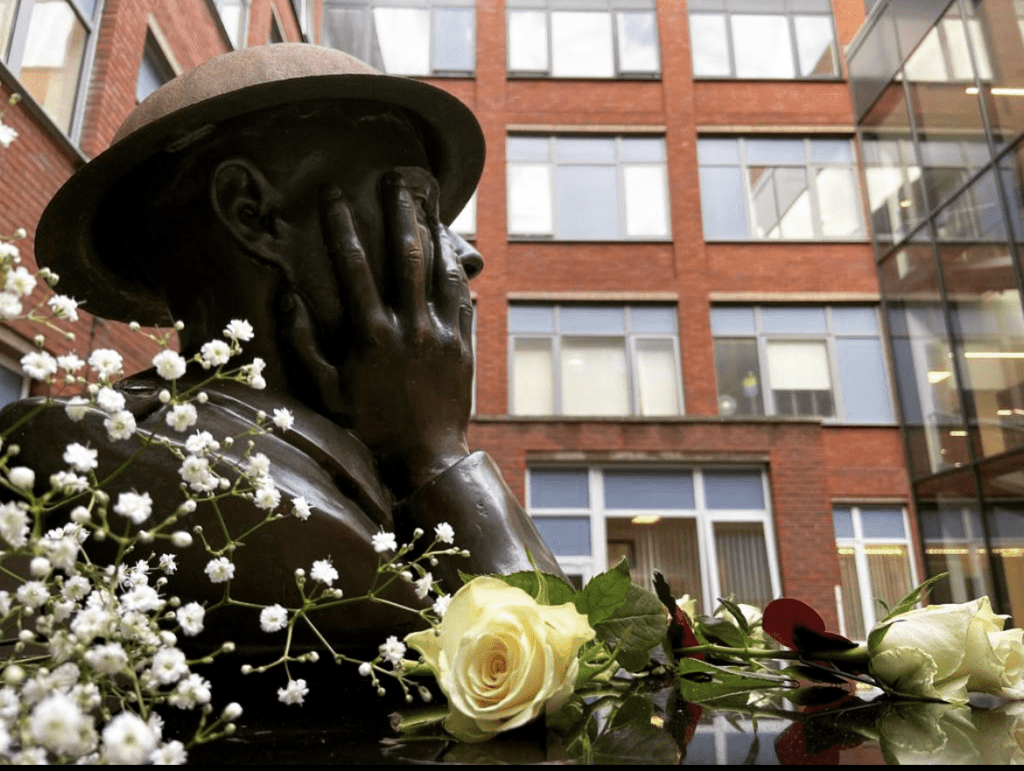
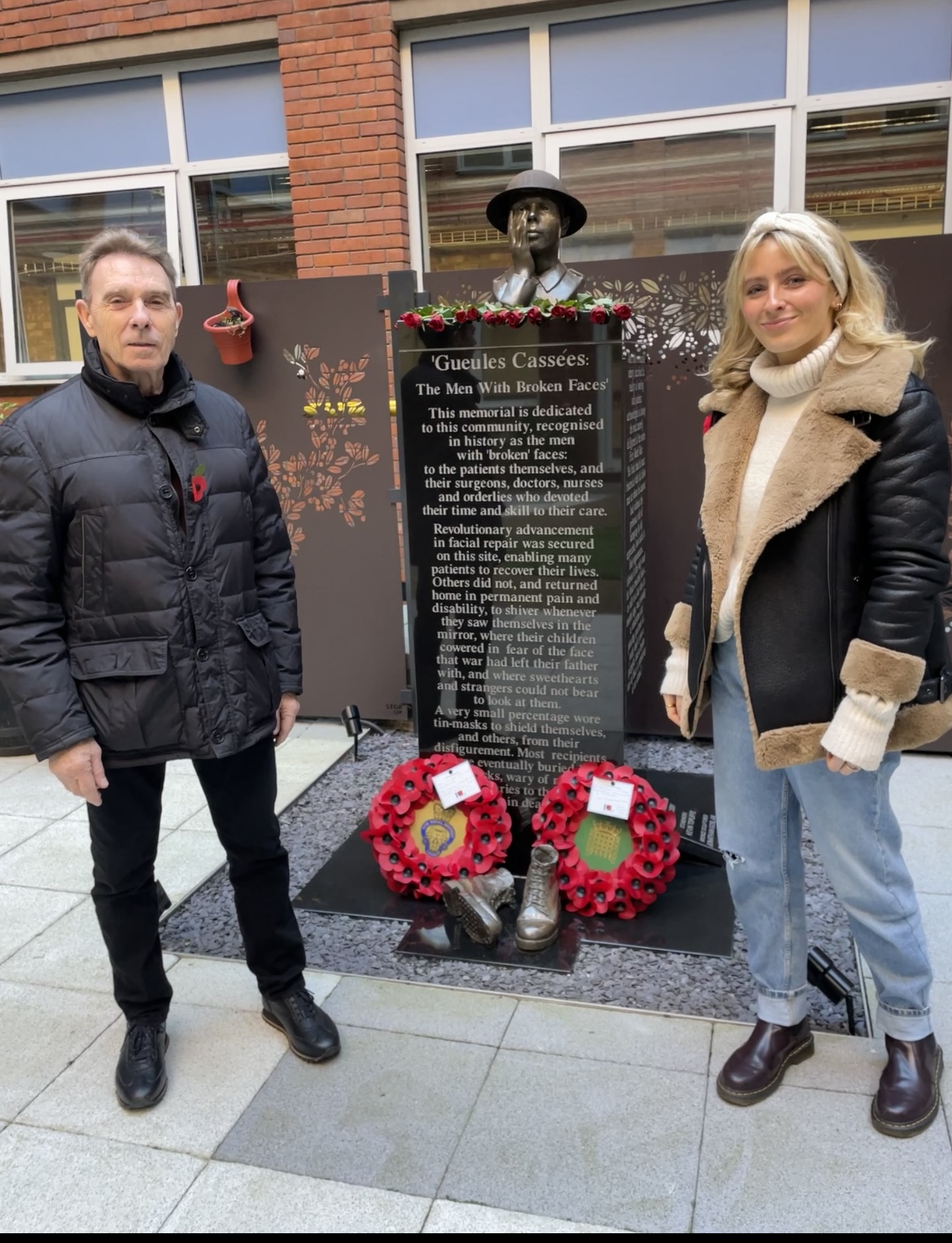
Whilst working on my MA on facially disfigured First World War soldiers, I realised amongst our wave of War Memorials in not just the UK but the world, one for facially disfigured soldiers was absent. There was a silence around this history but to me it was deafening, and I needed everybody else to hear it; I knew I had to make a dent in a broken narrative. In 2016 I tore off a piece of baking paper in my kitchen and started doodling. I had a vision, and I knew I needed help to bring my jumbled thoughts to life. I met with a 3D printing artist, and a stone mason and eventually we had a sketch flat on the surface looking up at us.
Seeing it, outside of my mind, something tangible now, I chased for it fiercely, slipping into the shoes of a historical activist for almost three years. This year is the 5th anniversary since its erection, my memorial is in the courtyard of Queen Mary’s Hospital in Sidcup, Kent, a War Hospital opened in 1917 to treat complex and acute facial wounds caused by The First World War. In 1995, I was born in it.
Fascinated by unintended consequences playing out in complex behavioural systems, I had so many questions about the facially disfigured, questions that seemingly had never been asked about them, their brains, their bodies, their faces their nervous systems, their hearts, and their families too and so my Ph.D. delves into the psychology of these wounds. At the over half-way point now of my Doctorate, I have created a database that has allowed a statistician to draw out averages and percentages that academia has never realised before from a sample of patients treated at the world’s cradle of modern plastic surgery, Queen’s. I spent around 5 months last year looking at pension records of facially disfigured veterans at The National Archives and have written a chapter on these soldiers as ‘old-men’ discovering stress-related deaths, suicides, life-long medical conditions, disturbed relationships with not only their precious loved ones, but themselves too and a failing government department: the Ministry of Pensions. Trawling through boxes of paperwork, including coroner’s reports on suicides and what was once un-explained deaths before medicine caught up, police reports, hand-written letters from strained children and wives, and the veteran’s themselves showing brutal honesty and raw emotions that war documentaries and films just do not show, I was often moved to tears in the archives. We don’t envision war veterans as old men seldom fully dressed, with empty eye sockets, in bed by 4pm, being fed pudding and cornflakes as a meal to avoid the mess, being rolled over to the side whilst their faeces and urine is cleaned off their bed sheets, in bed for 20 hours per day, until death. My research calls for a shift in remembrance, in our collective conditioning of memory and what The First World War caused long after the guns fell silent on the 11th hour of the 11th day of the 11th month.

My research looking at the surviving medical files from the war, that have never been questioned or analysed for their authenticity, is something I did exactly, and I believe they are curated versions, and the originals were either lost or destroyed. Revealing extraordinary case files from psychiatric patients to suicides on hospital grounds, I feel as if I have overturned something major, but what is most remarkable, is it has always been there, waiting for someone to speak out. I have researched my theory of curated patient files, tracing things like the paper they were printed on, to hand-writing matches from surgeons, to studying photographs of bed frames and patient notes on the walls, and more. My PhD has torn its own space, and I cannot wait for the world to hear about it.
After uncovering men’s acts of violence, both onto their own bodies and outwardly impacting others, gaining an understanding perceivably of their withdrawal from society and familial homes, and reaching crisis points of suicide and bodily self-harm, I began to ask questions about where this unresolved trauma and complicated emotional impact, after disfigurement, went. I asked myself could it just disappear; did it die with these men, young or old, or did it cease to exist when new life swaddled in a blanket was put into their arms, as they ‘got on’ with their lives? (This is a turn of phrase I have heard repeatedly whilst researching). Live testimony from the facially disfigured generation is now no longer tangible and so I turned to their descendants and set about interviewing their grandchildren, to see what legacy, if any, their complex lives left behind. On the brink of the interview process, I was fixated on the loss of the veteran’s voices, that I was ‘too late’ but motivated in the belief I could encounter some stimulating memory recall. It was not until I started talking with a range of descendants that I discovered more than memory but: impact; the ripple effects, like the supersonic velocities after a bomb blast. In some families, to me, the writing was on the walls, in others, it was delicate, complex and subtly exposed where I needed to turn to other disciplines to both draw it out and to understand it and so the artery pumping blood through my historical Ph.D. is psychological theory.
So many of my questions with descendants are met with silence, tears, sniffs, pauses, throat clearances, laughter, raised eyebrows, and speech stumbling. The ‘old’ me would have thought I was an unwanted intruder, that I had over-stepped etiquette, that these are things you just do not ask, that you should, just, know. ‘Madness’ as a constantly evolving psychological condition throughout history has always fascinated me; not thinking the same as everyone else is so often seen as disorderly, as strange, needing to be labelled and set apart from the rest. My project has taken me down so many rabbit holes and as one of my favourite novelists wrote: ‘we’re all mad around here,’ I have come to think if you can explain your madness, it just can’t be, can it?
Ellie is a PhD Researcher at the University of Reading, and is currently crowdfunding to continue her insightful and highly relevant project on facial disfigurement. If you would like to support her project, you can donate here: https://www.justgiving.com/crowdfunding/ellie-grigsby?utm_term=b3XeMQDz6

 READING HISTORY
You must be logged in to post a comment.