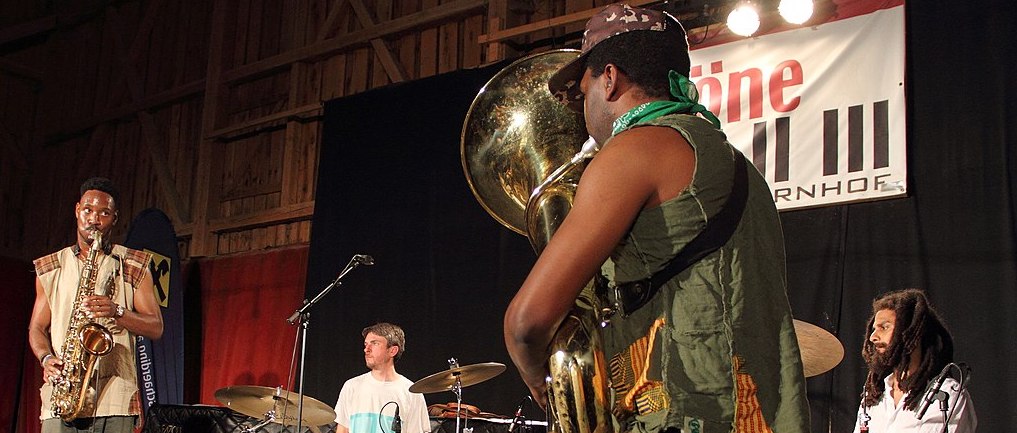
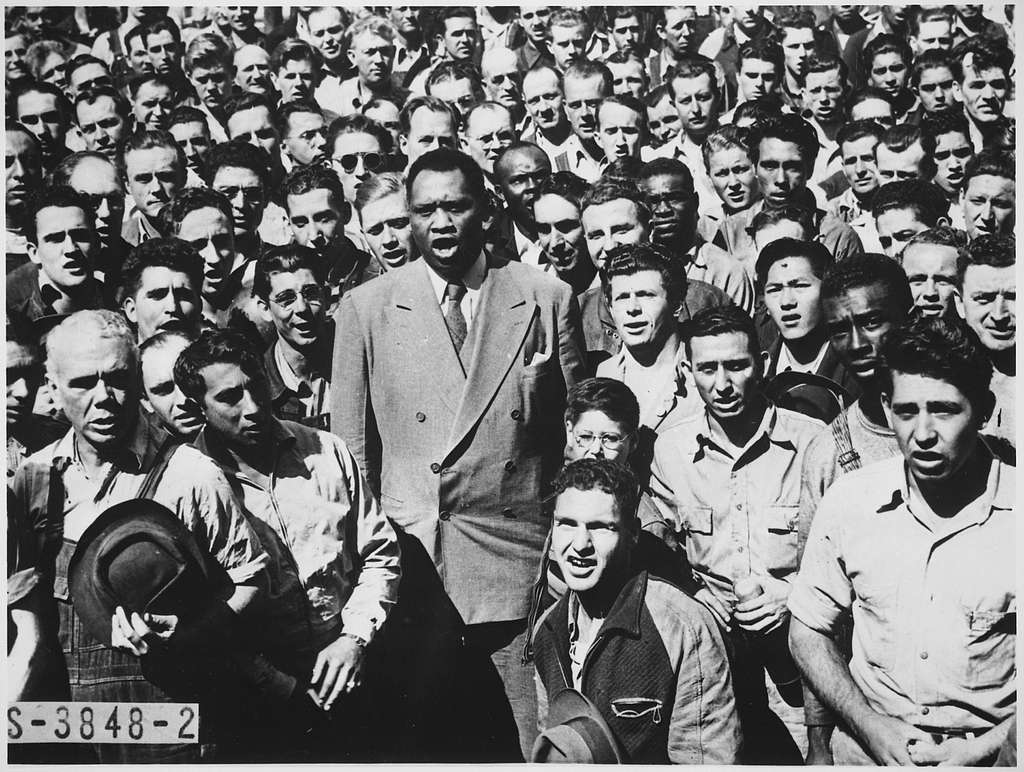
Paul Robeson, world famous baritone, leading Moore Shipyard (Oakland, CA) workers in singing “The Star Spangled Banner” in 1942.
We are marking Black History Month this year by celebrating the diverse history of Black musical cultures. This culminates in an afternoon of music, talks, and discussion on Wednesday 30 October , including a talk by reggae expert Prof. William ‘Lez’ Henry (University of West London). Before then, however, we have two blogs for you. In this first blog you can find a selection of tracks that indicate the enormous variety of sounds and approaches embraced by Black musicians over the last century, chosen and introduced by members of staff from across the Department of History and the wider School of Humanities.
Abdullah Ibrahim – “Mannenberg” (Chosen by Dr Heike Schmidt)
Abdullah Ibrahim was classified as ‘Coloured’ by South Africa’s apartheid regime which introduced a division of the population into four different races and racial segregation. When I first lived in Africa for thirteen months, in neighbouring Zimbabwe in my early 20s, listening to Abdullah Ibrahim, especially his song “Mannenberg”, was an expression of solidarity. The extraordinary quality and beauty of the improvisation, the tone and mood make for a quiet moment of connecting with the world we live in and hopefully choosing to live with compassion and courage.
Angeline Morrison – “Black John” (Chosen by Dr Richard Blakemore)
Angeline Morrison, a folk singer and instrumentalist, whose Sorrow Songs album brings together stories from Black British history. I particularly like “Black John”, about John Ystumllyn, an eighteenth-century gardener and horticulturalist in Wales.
Baaba Maal – “Yerimayo Celebration” (Chosen by Dr Benjamin Bland)
The legendary Senegalese singer and guitarist Baaba Maal is now in his seventies, but that hasn’t stopped him from recently releasing what might be a career-best album, Being. Maal primarily sings in Pulaar, a Fula language spoken primarily along the Senegal River, and is well known for fusing traditional African sounds with other styles from around the world – everything from ragga and soul to cumbia and electronica. This addictive track gives some indication of his unique, but accessible, style.
The Beat – “Mirror in the Bathroom” (Chosen by Dr Dan Renshaw)
This might be one of my favourite songs of all time, of any genre or period. An incredibly unsettling evocation of the external and internal pressures of Thatcher’s Britain, with an amazing bassline.
Courtney Melody – “The Night Before” (Chosen by Dr Neil Cocks)
It is one of the handful of songs that changed my life – I heard it, and nothing sounded the same after. I have heard it thousands of times subsequently, and it remains as great as listen one – especially fitting for a song about repetition.
Dream Warriors – “My Definition of a Boombastic Jazz Style” (Chosen by Prof. Melani Schroeter)
You’ll get a lot of political suggestions, rightly so, but I also think that there should also be some life-affirming fun in this…
Henri Salvador – “Dans mon île” (Chosen by Prof. Joel Felix)
Henri Salvador (born in French Guiana and of Guadeloupean heritage) was a very popular singer and musician in France, often merging musical genres from Guadeloupe with the French styles of the day.
Howlin’ Wolf – “Killing Floor” (Chosen by Prof. Jane Setter)
In the blues tradition, a number of songs originally by Black artists were famously ‘modified’ by Led Zeppelin – one of them being Howlin’ Wolf’s “Killing Floor” (1964). It took until a lawsuit in the early 1970s for Howlin’ Wolf to receive a credit for the song on Led Zeppelin albums.
Lord Kitchener – “London is the Place for Me” (Chosen by Dr Natalie Thomlinson)
Kitch, a Trinidadian calypso star, composed it when sailing to Britain when on the legendary Empire Windrush. It’s a song more optimistic than the subsequent experience of Caribbean migrants warranted – but in invoking the timeless appeal of the big city, it is unparalleled.
Mariah Carey – “Fly Like a Bird” (Chosen by Dr Jatinder Mann)
I am a huge Mariah fan, but I especially like her Gospel infused songs, and this is an excellent example. This song has special resonance with me as it helped me get through a particularly difficult time in my life.
Rhiannon Giddens (with Francesco Turrisi) – “Wayfaring Stranger” (Chosen by Dr Elizabeth M. Barnes)
A nineteenth century spiritual that was almost certainly a slave song originally. This version brings traditional mediterranean folk instruments into the mix so it’s an interesting new approach to a song that must have been recorded dozens of times.
Nina Simone – “Here Comes the Sun” (Chosen by Prof. Gail Marshall)
Better than The Beatles version, and an excellent example of how a cover can compellingly re-work the original song.
Paul Robeson – “Joe Hill” (Chosen by Dr Jeremy Burchardt)
A great example of how one form of oppression can give rise to empathy and solidarity with other oppressed groups. Robeson’s strength, courage and dignity still speak to us loud and clear.
Sons of Kemet – “My Queen is Ada Eastman” (Chosen by Dr Sam Agbamu)
Ada Eastman is Sons of Kemet saxophonist Shabaka Hutchings’ grandmother. All the tracks on this album – Your Queen is a Reptile – are named for powerful Black woman, and the last is for Doreen Lawrence (mother of Stephen Lawrence and an anti-racist campaigner after her son was murdered by racist thugs in 1993). As immigrants, we owe so much to our elders, who established a life here, facing down racist governments and carving out a space for us here. Events of the past year and over the summer give an additional edge of defiance to the closing verse of this song:
Call me a roach, ’cause I’m resilient / I’m born strong, the son of an immigrant / Struggling element / And I’ll be here / I’ll be here when your cities are sediment / And only your borders and fences are left / I’ll be here when your banks stop selling debt / And all your leaders stop selling death […] I’m still here; I’m still here; I’m still here…
If you’re interested in finding out more about the history of Black musical cultures, then look out for the second blog later this week and don’t forget to come along to the department’s Black History Month event on 30 October. For more information, please contact the organisers, Dr Benjamin Bland (b.bland@reading.ac.uk) and Dr Daniel Renshaw (d.g.renshaw@reading.ac.uk).
These were only some of the selections made by staff members. You can find a longer playlist below and feel free to let us know what you would have chosen via social media!
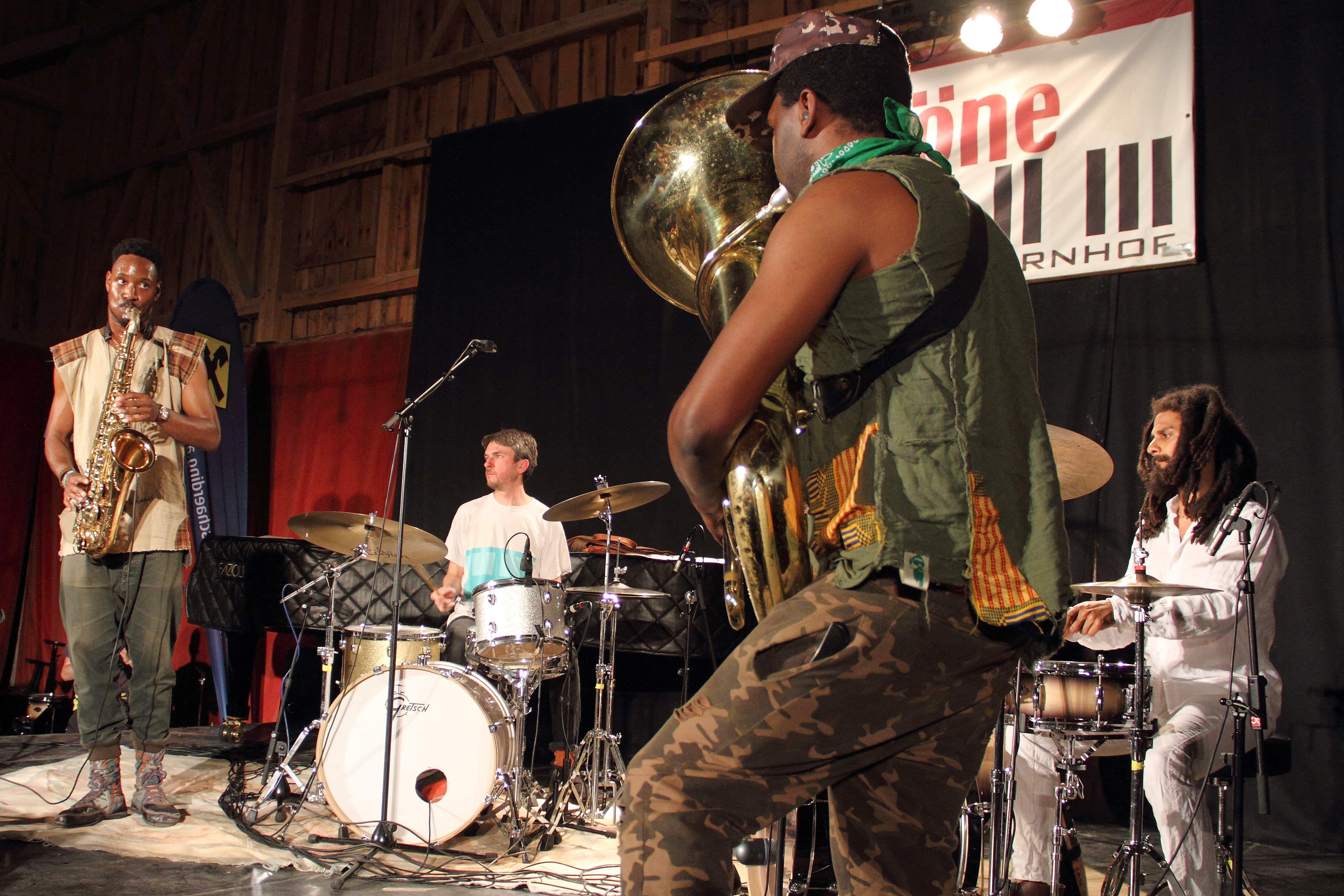
Sons of Kemet (photographed by Schorle) via Wikimedia Commons

 READING HISTORY

You must be logged in to post a comment.