
Amy Longmuir explores women’s activism in our town in the 1970s.
As a lifelong Reading resident, when one of the largest towns in the UK comes up in my research on the British Women’s Liberation Movement, I am particularly interested in what was happening and where. Two recent archive visits to the Feminist Archive South, held at the University of Bristol, and the Feminist Library in Peckham, have proved fruitful in my attempts to find local activism and engagement with ideas of women’s liberation in Reading.
Origins of the WLM
The Women’s Liberation Movement (WLM) began across the western world towards the end of the 1960s. In Britain, it is commonly cited as starting with the Ford Dagenham Sewing Machinists’ Strike in 1968, where some 187 women went on strike against being labelled unskilled whilst men doing similar jobs were always labelled semi-skilled. The result of this was considerable news and government attention on women militant workers. There was a parliamentary inquiry into the dispute and Barbara Castle MP, then Secretary of State for Employment and Productivity, met with the striking women.

Walton Street site, Ruskin College, Oxford. The institution moved to a new site in 2012.
A year later, the first Women’s Liberation conference was held at Ruskin College, Oxford with around 600 women and men attending, many with their young children due to a creche being provided by the organisers. Key in organising this was Sheila Rowbotham, a prominent figure in the British WLM and feminism, who continued to be influential throughout the period, including her 1973 book Hidden From History which examined specifically women’s oppression from the seventeenth century to the 1930s.
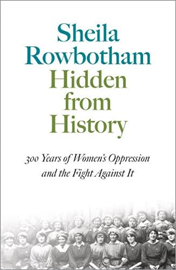
Sheila Rowbotham, Hidden From History
From this, the WLM exploded across Britain, with practical and theoretical women’s groups set up across the country. A key part of the WLM’s campaigning centred around consciousness-raising, with focus placed on small groups of women coming together to discuss their experiences and form an understanding of their oppression. This happened alongside larger campaigns that were both political and social, including the Working Women’s Charter Campaign which, as the rest of the British Women’s Liberation Movement (BWLM), demanded equal pay, opportunities, education, working conditions and legal rights for women.
But what does this have to do with Reading?
At the Feminist Library in Peckham, one edition of the Reading Womens Group Magazine exists, and provides insight into how the women’s liberation movement operated in the local area.
Formed in March 1974, the group ‘attracted many new women to it’s weekly meetings’.[1] A large number of BWLM groups emerged in the early 1970s, and Reading’s group seems to be very closely aligned to the national BWLM’s aims and campaigns. The contents of this magazine focuses considerably on national campaigns with articles including; ‘Abortion: a woman’s right to choose’ which discusses the National Abortion Campaign; ‘Women through the eyes of the media’; ‘Feminism and the revolutionary left’; and ‘Wages for Housework’.[2] In doing so, the group very clearly engaged with the national movement, and were aware of how their campaigning could relate to national campaigns.
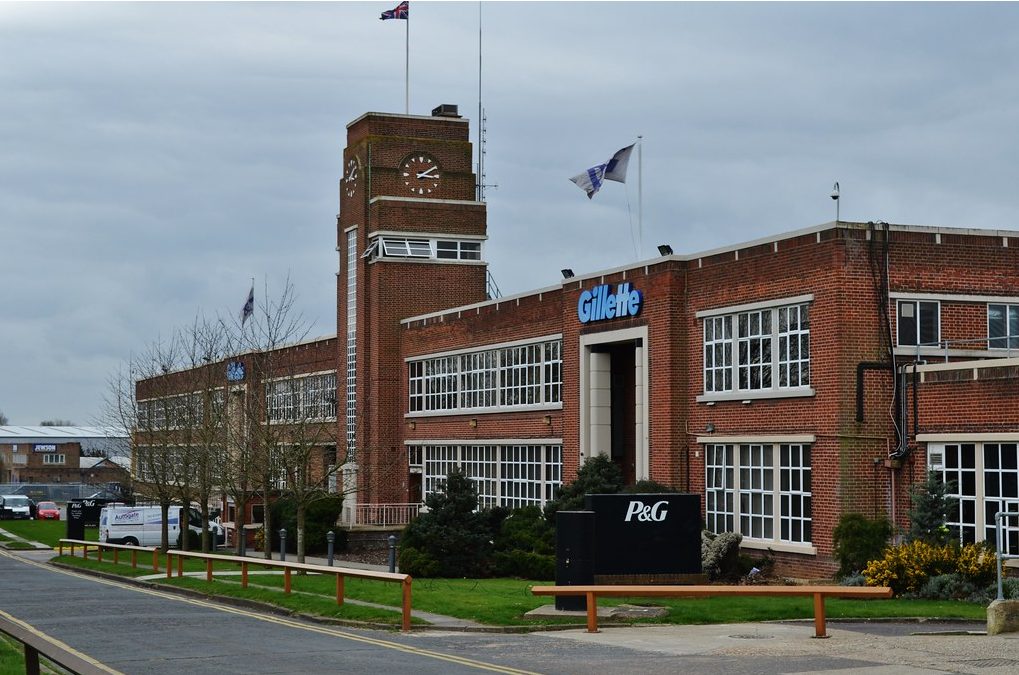
Gillette Building, Basingstoke Road, Reading
They also focused on local matters; in an article by Ros Makin entitled ‘Reading Women’s group and Gillette’s’.[3] Makin stated that Gillette’s was ‘one of the largest factories in Reading, and employees mainly women’, though ‘the problems the women at Gillette face are great’.[4] Despite the Reading Women’s Group believing that the women were unable to organise, tended ‘to regard their jobs as of little importance’, and were ‘generally passive, and lacking in confidence’, there was little physical engagement with the Gillette’s women. The article stated that ‘so far the group has put two leaflets into Gillette’s…and we hope that a few of the women will eventually respond to our efforts’.[5] Notably then, despite Reading Women’s Group stating that their aim was to ‘reach working class women with our ideas’, they remained reluctant to engage with working-class women face-to-face, instead solely sending in leaflets.
We cannot be too dismissive of these attempts, though, as the women both writing the newsletter and attempting to engage working-class women were also women who were attempting to understand their own oppression by both their gender and class. In the Editorial, it is stated that ‘a woman going to a women’s group…is more likely that she will be confronted with a group of women just as confused as herself, trying to work out some direction in the movement’.[6] Their hope then, to engage with local women at Gillette’s was something that was intended to provide ‘information on the local…events connected with women’s issues’, and understand how the BWLM’s demands could be located in the local area, rather than of intense theoretical and practical implementation.[7]
Evidence of a women’s group in Reading can also be found in 1982; an article from Reading University Women’s Group in number 132 of the periodical Women’s Information and Referral Service (WIRES) discussed the problems the local group were having.[8] At a union meeting on Thursday 17 June, they were accused of refusing ‘membership to male students on grounds of their sex, and also to female students because of opposition political beliefs. In addition they restrict attendance of open meetings on grounds of sex’.[9] Denying this, the Women’s Group attempted to defend their ‘right to organise autonomously’, stating that they will cease to exist if the Students’ Union continued to target them.[10] They asked for ‘letters condemning this action and supporting our cause’ to be sent to the president of the Reading University Students’ Union, along with messages of support and donations.[11]
In doing so, they placed Reading within the national network of women’s groups attempting to organise collectively, as well as highlighting a key problematic area for the BWLM: what was its theoretical leaning, and should men be allowed to be involved. This later question would be one that divided the national BWLM by the middle of the 1970s as the influence of Radical and Revolutionary feminists came to the fore and the question of whether ‘all men…possessing power over all women through their membership of the superior sex class’ was true of male-female relations became ever present in BWLM discussions.[12]
Locating Reading’s Women’s Groups
Aside from their theoretical discussion of women’s oppression and their attempts to engage with local working-class women, there is some evidence in their periodicals of where these groups could be found.
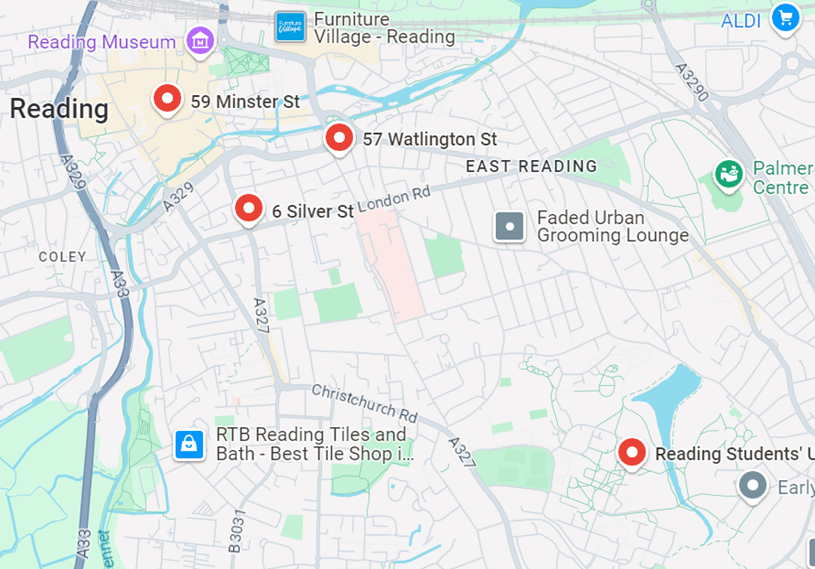
[The four red dots here show the key locations for Reading Women’s Liberation Movement Activism (Google Maps)]
Like a number of BWLM groups, much of the earlier information about these groups is in the form of a ‘care-of’ address or meeting place, normally being the home of one of the key organising women in the group. In the Reading Womens Group Magazine published around 1974, the group was meeting every Monday at the Trade Union Club, Minster Street, suggesting that the women involved had some knowledge of trade unionism, even if this was only through having the contact of those running the club.[13] In 1977, the Reading Women’s Group’s mailing address is care of ‘A. Moore, 57 Watlington Street, Reading Berks.’[14] Obviously, there was a group based at Reading University Students’ Union, though the addresses of the individuals involved is not included anywhere.
What can also be found is evidence of a Reading Women’s Advice and Information Centre. Although there is very little information about the centre’s running, it is stated to open in Summer 1986 at 6 Silver Street, providing ‘information and advice covering a large range of subjects – support and counselling – free pregnancy testing – activities and events – newsletters etc…’[15] Despite there not being extensive information about the centre, there is some information found in the local ‘radical non-aligned’, Red Rag (not the same Red Rag as the national newspaper!) that gave updates on the centre.[16] It stated that ‘the cost of the building work will hopefully be covered by a grant we have received from the Borough Council’, and the centre will also ‘house the office of the Well-Woman Association’.[17] The engagement of the council alongside women’s associations demonstrated the significance of this location as a female-centric space that was considered important for the community.
So What?
A key element of the BWLM is that it was not centralised. There was no organising body, no national membership and no overruling committee deciding on the movement’s direction. Evidence of local organisation like that described here is something that showcases just that; sporadic, locally organised and created, collective campaigning that engaged with the BWLM’s aims and demands to improve women’s freedoms in society. Despite most of the places now being demolished, the archival traces that can be found of them showcase a history of local activism that is not centred on the large cities in the UK, but a heavily industrial town on the M4 corridor during a period of considerable economic and political change.
Amy Longmuir is a SWWDTP-funded PhD Student at the University of Reading, researching socialist-feminism and ideas of work in the British Women’s Liberation Movement.
[1] ‘Editorial’ Reading Womens Group Magazine, p.2. London, Feminist Library.
[2] Reading Womens Group Magazine, p.3.
[3] Ibid., p.30.
[4] Ibid.
[5] Ibid.
[6] Ibid., p.2
[7] Ibid.
[8] Reading University Women’s Group, ‘We Need Your Support!, WIRES, 132 [1982], p.9. Bristol, University of Bristol Special Collections – Feminist Archive South.
[9] Ibid.
[10] Ibid.
[11] Ibid.
[12] J. Rees, ‘A Look Back at Anger: the Women’s Liberation Movement in 1978’, Women’s History Review, 19(3) (2010), p.342.
[13] Reading Womens Group Magazine, p.34.
[14] ‘Working Women’s Charter Campaign Groups’, Working Womens Charter Campaign London Newsletter, 4 (1977), p.10. London, Feminist Library.
[15] WIRES, Bristol, University of Bristol Special Collections – Feminist Archive South.
[16] ‘Introduction’, Red Rag: Reading’s Only Newspaper 1979-1987, [website], https://www.readings-only-newspaper.org/, (accessed: 02/10/2024).
[17] ‘Silver Street Women’s Centre Takes Shape’, Red Rag, 23 September 1986, https://www.readings-only-newspaper.org/issue/1986/1986-09-23.txt

 READING HISTORY
You must be logged in to post a comment.