
As we start to wind down ahead of the winter vacation, Dr Dina Rezk reflects on the power of the arts to engage us and enrich our thinking.
A few months ago, a friend sent me a flyer of a play showing down the road at Battersea Arts Centre. I’ve never much been into theatre. But I had the feeling that this was not going to be traditional ‘theatre’. It was a one man show by actor, activist and fellow Egyptian Khalid Abdalla (most will recognise him as Dodi Al Fayed in The Crown). The play was called Nowhere, described somewhat obscurely as an anti-biography. Now. Here. Nowhere.
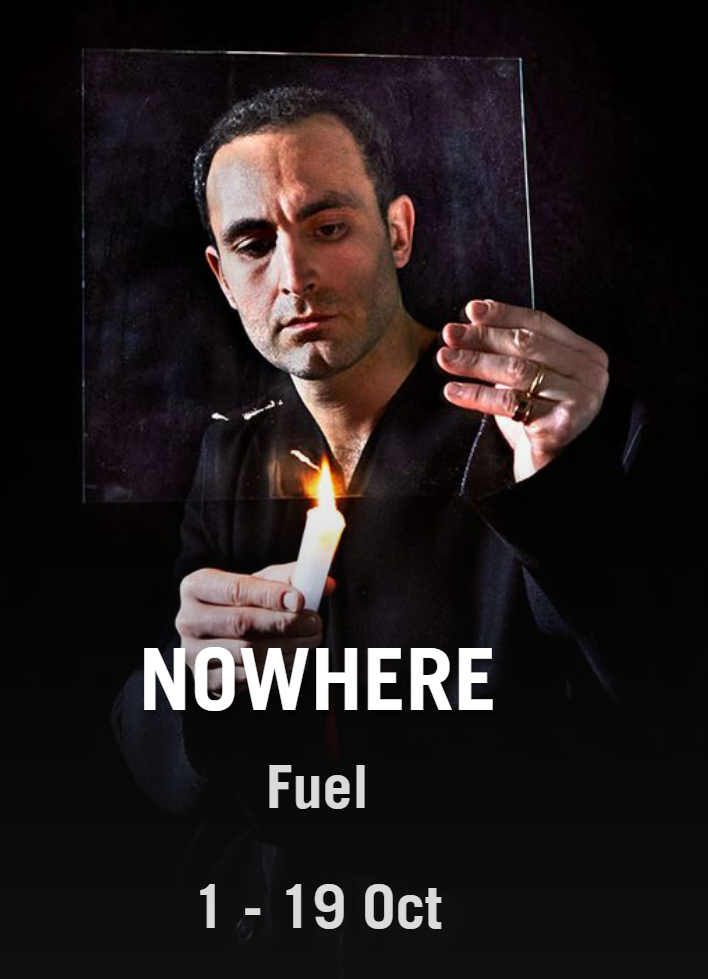
It was a typically miserable frosty October evening; the tickets were sold out. But I decided to show up anyway. I had been following Khalid’s career from afar as part of a research project I had been working on looking at the relationship between politics and popular culture in Egypt’s ‘Arab Soring.’ Like many Egyptian activists, Khalid was one of thousands who put their lives on the line for the possibility of change over a decade ago. His performance in The Square (2013) brilliantly documented the vital role he, and other Egyptians, played in giving voice to the desire for freedom that defined the protests of 2011. ‘Only we can tell our stories’ he insisted in a scene that I show my students every year and still sends a shiver though my spine.
If nothing else, I knew that Khalid would deliver a good story. But beyond I had no idea what to expect. From the moment he came on stage, I was transfixed. The ‘performance’ if you can call it that, was a refreshingly non-linear, deeply personal and political meditation on life as a British-Egyptian, exiled in both not quite homelands. Using an innovative mixture of narrative, music and dance, he moved seamlessly from scenes of more classic storytelling directly addressing the audience to drawing on a mosaic of multi-media images and at one point even getting us all to do self-portraits (if you haven’t already tried this then I recommend it!) Somehow he took us though a postcolonial history of the 2011 Egyptian ‘Arab Spring’, the clash of (and arguably on) civilisations brought on by 9/11, the legacy of which remains a part of all our everyday lives (‘See it, say it, sorted’), and the death of his friend from pancreatic cancer, all rolled into one. It was strange and compelling and deeply moving.
My issue with theatre has always been that I find it hard to suspend disbelief. But there was nothing to disbelieve on that stage and the questions he invited. ‘If not now, when?’ Abdalla asked. If nowhere is safe for some people, then nowhere is really safe for any of us. It was an invigorating reflection on grief and hope, asking the fundamental question that most of us have likely been asking ourselves lately: how do we live in a world that constantly moves from crisis to crisis. And perhaps even more so, how does that world live in us?
Afterwards I wrote to Khalid to thank him. To tell him that his play reminded me that perhaps it is the revolutions that take place within, and between us, in squares and in theatres, that really make the difference. It reminded me that art in all its forms nourishes us, and that the best art energises and lights us up. It makes something of the human experience that we can share that is beautiful and thought-provoking. Something that touches others and maybe even makes our heart sing. As I look back on this year, I’m so glad I turned up to the theatre on that cold October night. It warmed me up and provided a salve of inspiration and connection that I hadn’t even realised I needed.

 READING HISTORY
You must be logged in to post a comment.