
For Women’s History Month this year, we wanted to focus on the women in our lives – ordinary women who have made significant contributions in their own way. To start us off, Abbie Tibbott writes about her own experiences tracing her family history.
March is when we celebrate Women’s History Month, and this year, I wanted to swing the focus toward our own narratives. I have been researching my own family tree sporadically since 2016, shortly after I came to Reading. My last great-grandparent died in 2001, and although there are photos of us together, I don’t have any solid memories.
My parents have always collected photos and videos. When I was young, my parents put a lot of ‘home movies’ on film. For my birthday a few years ago, I had them put on a set of DVDs. Seeing my Grannie, who passed in 2021, alive and well (and being rather chaotic at times) brings back a lot of happy memories. She was the first incredible loss I have experienced in my life, and I feel grateful that I can turn on my TV and see her again and again. My family tree offered me a similar feeling, of thinking about my family before I came along.

This year, we asked students to fill in a short form about a woman in their family. I then turned the submissions we received into posters, which are now on display. Although it may seem a little sad that we can sum up a person’s life on one side of A4, it is a testament to how much we value our past that we actually want to remember it in the first place.
The subject of my poster, Hannah Cousins (my second great-grandmother), is especially interesting to me. I can’t remember anyone ever discussing her before I started work on my family tree. Bringing her back to ‘life’ is something I take great pride in. I am proud of my heritage and where I come from, even though my parents moved from Chesterfield to the Isle of Wight in May 2005, almost twenty years ago.

My sense of identity is irrevocably tied to this market town where I spent just over six years of my life. People ask me where I’m from, and I always say I grew up in Chesterfield. My memories of it are clouded. I remember going to dancing lessons, sleepovers at Grannie’s house and trips to Clumber Park. I don’t remember much about my school, apart from that we raised chicks and butterflies. I don’t remember the house where we lived when I was a baby, but I do remember the next house, where I played in a small paddling pool on the hot patio, and where my mum begrudgingly carved me a pumpkin so I could pose next to it in my cute witch costume. The photos bring it all back to life.
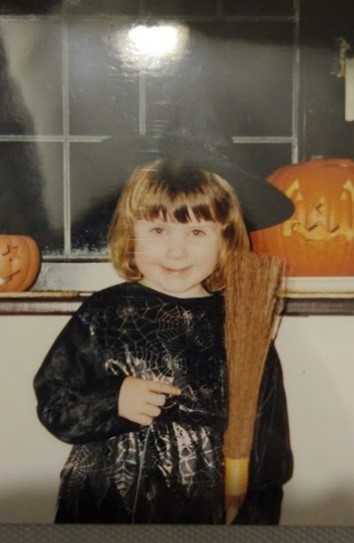
Still, I always say that’s where I’m from. My northern accent comes out in my vowels and greetings, but for twenty years now I have been gone, over eight of those spent here in Reading. I still feel attached to the place and people that came before me, and I think I always will.
My parents have more of a grounding away from the Island, their accents remain more tangible and as I have got older, they have begun to share more about their younger selves. It is a privilege to hear their stories, as it highlights why I was raised the way I was. My mum is an independent, strong-willed and pragmatic woman who can always find a solution. My dad is quieter, amusing and loves me fiercely. I am optimistic, rational and not afraid of sticking my head above the parapet. I used to be shy; I grew out of that after I left home. Now I am not afraid to be who I am. They are not perfect, neither am I, but I can see where it all comes from.
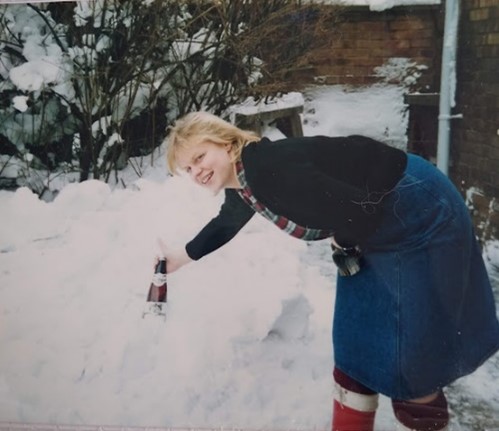
It’s important that we take time to remember that we come from somewhere. We don’t have to feel positive about this, and it doesn’t have to define us. We might heal from it; we may never have the strength to. I wish that I could have chosen Grannie for my poster, but it feels too difficult, like she’s still just out of reach. I saw something rather wistful online recently that suggested that we are the sum of generations of people who loved each other across time. A little idealistic, but I see the point that was being made. Regardless, our narratives play a part in who we are.
The contributions to this project have demonstrated how different we all are. From different parts of the world, from different communities. Yet, we have all ended up here somehow. This snapshot in time places us here, at the University of Reading. It may be fleeting in the grand scheme of things, but it matters. I wanted to run this project and hand the challenge over to our students to demonstrate that our personal pasts matter just as much as the types of history we research, and they have certainly delivered.
Stay tuned over the course of the month to hear from women in the Reading History community about their own family histories.

 READING HISTORY
You must be logged in to post a comment.