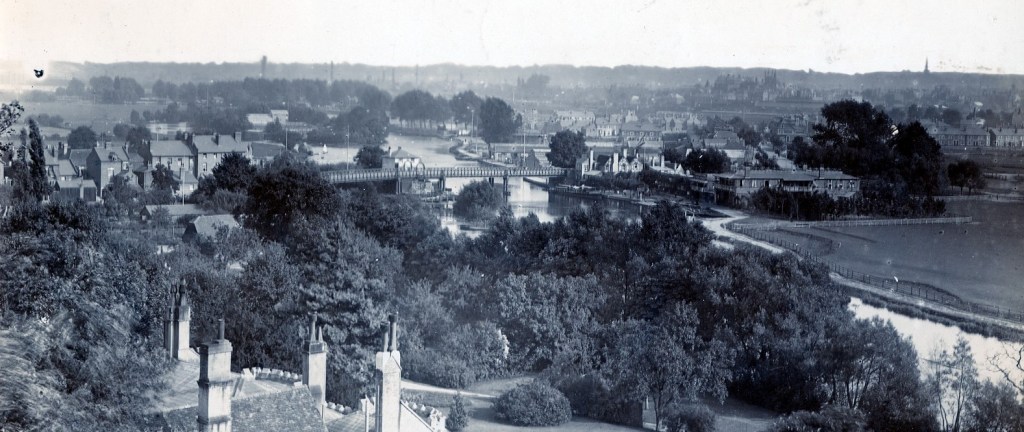
Our friend Mark Stevens, the County Archivist at the Royal Berkshire Archives, introduces their new exhibition that opened on Monday 9th June.

The Thames may, at first sight, look uncontrolled. And it can be. In 1519, it was considered to be the source of plague that swept through Oxford. While in 1809, floodwaters destroyed many features, including the bridges at Wallingford and Windsor. But look closer at the river, and you can see that the Thames we know has been shaped hugely by human interaction. And that’s as far back as people have lived beside it.
The chronicles of Abingdon Abbey, no less, record how Saxon locals petitioned the Abbot to divert the river through his meadow, so that their row boats would no longer stick in one particular shallows. The Abbot duly obliged and then fixed the Thames’ first toll: that every one of those row boat owners, to pay for their safe passage, must give him one hundred herrings (or whitefish in modern parlance).
Away from Berkshire’s burgeoning fish economy, the real money was to be found in weirs. These were built as dams to divert more water to the mills that lined the river. These weirs weren’t popular. The reasons were various: they increased flood risk; they trapped rubbish and created pollution; they caught fry and decimated that all-important herring population. Those were problems for the townsfolk of the river. Far worse, in financial terms, was that the weirs caused obstructions to bargemen. Those bargemen had some very rich friends – merchants in Oxford or London.
Almost every decade, from the twelfth century onwards was some sort of petition presented to Parliament, lamenting the man-made interference with the Thames. Yet with vested interests pitted against each other – merchants on one side, landowners on the other – it took centuries before the nettle was grasped. That it was grasped was due to canal mania and the demands of the industrial revolution. In 1771, the Thames Navigation Commission was set up. Empowered by Government, it set about building almost all the locks that we know today. New cuts for those locks were made in the river while the old weirs were stripped away. It was the Georgian equivalent of HS2.
But for that brief period of colossal investment, the river as we know it may look very different. Now in due course, all that expected canal trade went the way of the railways. The Commission went bankrupt and morphed into the Thames Conservancy. And it’s the Conservancy that you will see much in evidence in our exhibition.
The Conservancy did maintain the river for business. For business on the river did continue, if not at the levels that the Georgians hoped for. But, of greater long-term value, is that the Conservancy had powers to maintain the river as something clean and thriving. Not for the upper Thames the indignities of the lower, tidal river in London, with a famous declaration in 1957 that it was ‘biologically dead’. On the contrary, that part of the Thames that we know and live beside has always been healthy. And long may that continue.
And so, the exhibition reflects that river Thames – our river Thames. These days, as a place of recreation and leisure more so than money and sustenance. But still as a place shaped by human interaction. And interaction that, well, reflects the nature of that word, ‘Conservancy’. The nature of keeping something safe, and of caring for it.
The lovely thing, of course, is that now, anyone can be a Thames conservator. And we – that is the Royal we of the Berkshire Archives – we see ourselves as one, and this exhibition as a work of Conservancy. It is us playing our own small part in controlling the Thames, caring for it, and keeping its history safe.

You can visit ‘Our River Thames’ at the Royal Berkshire Archives until Friday 29 August.

 READING HISTORY
You must be logged in to post a comment.