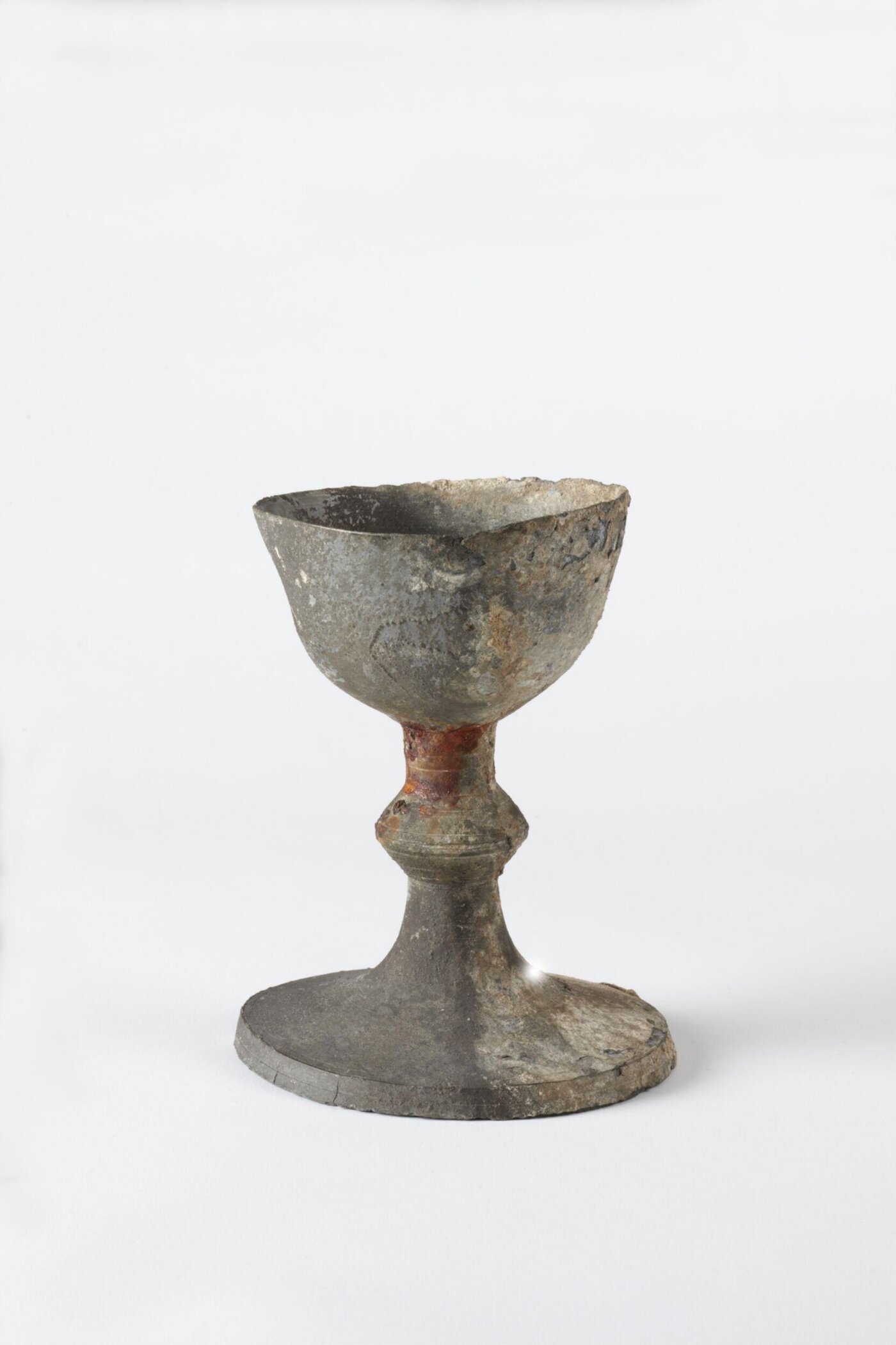
Our MA student, Maebh Springbett, examines a medieval pewter chalice held in the collection of Reading Museum.

In the centre of a dusty cave lit by dancing flames, the knight sits waiting. He is flanked by a grand display of ornate chalices. Some silver, some gold, some jewelled. ‘He chose…poorly’ he says calmly, addressing the shattered skeleton on the ground. Indiana Jones swiftly crosses to the array of chalices. Selecting a small, simple cup from the collection, he drinks from it. ‘You have chosen wisely’, the knight says.
Fans of Indiana Jones may recognise this iconic scene from the 1989 film The Last Crusade, in which the whip-wielding archaeologist hunts down the Holy Grail before it ends up in the wrong hands. The Holy Grail is without a doubt the most recognised chalice in history. As the cup believed to be used by Jesus at the Last Supper, its legend has been a regular feature in pop culture from films as infamous as Monty Python and the Holy Grail, to renowned books like The Da Vinci Code.
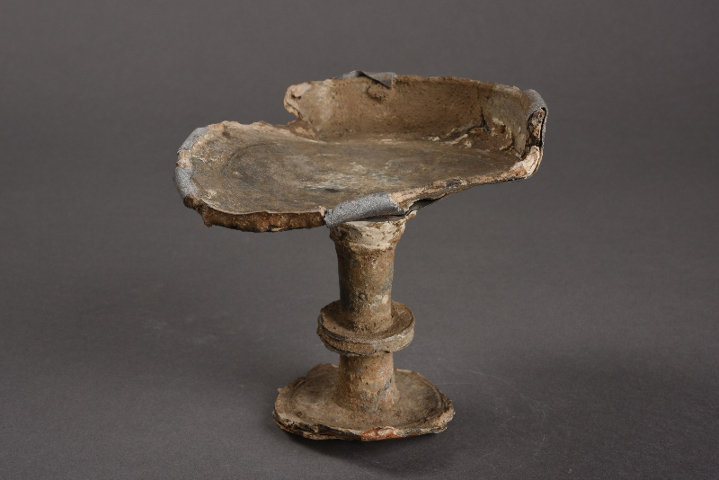
Though far less famous (and unable to offer immortality, unfortunately), a medieval pewter chalice found in Reading Museum’s ‘Story of Reading’ Gallery is surprisingly similar to the one Harrison Ford dangled over a chasm attempting to retrieve. While its cracks and chipped edges show it’s seen better days, this chalice is comparably unassuming, measuring just 10cm tall with a basic design. There is also a lot more to this chalice than may first appear.
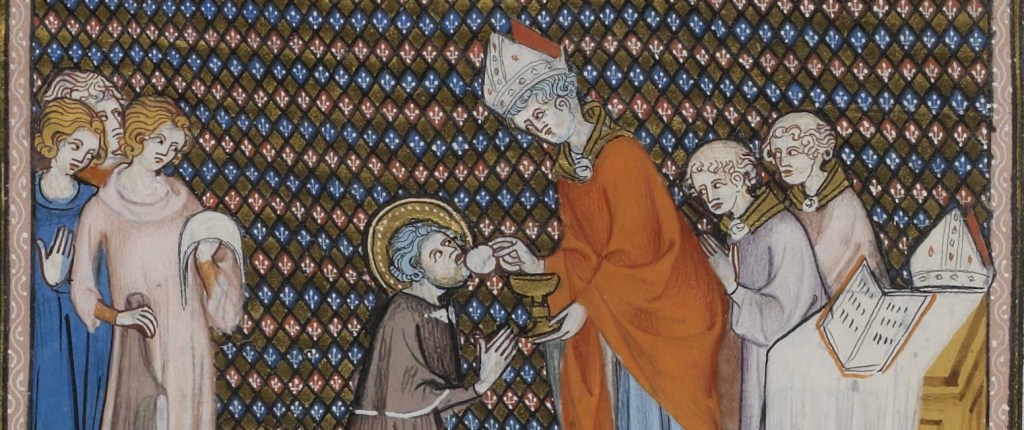
It is made from pewter, a metal alloy often used for tableware in the Middle Ages. Until the 1500s the Church was the largest consumer of pewter in England, during which time multiple councils regulated its use for different purposes in the Church. At first pewter chalices were usually second choice for carrying out Mass, when ones made from gold or silver were too expensive. As the main act of worship in the Catholic Church, during which bread and wine are consecrated and become the body and blood of Christ, Mass is perhaps the most well-known use for a chalice. As the Middle Ages progressed though, chalices made from pewter were generally only used for giving communion to the sick, serving unconsecrated wine to the congregation after communion or burial with a priest. This last function was customary by 1100, the idea being that this was a pewter copy of the sacred vessels made from precious metals. The priest’s chalice was often accompanied by a paten, a small plate for holding bread that sometimes served as a lid for the chalice. In priestly burials these symbolised Christ’s tomb and the stone before it, as well as marking out the deceased’s status as a church official.
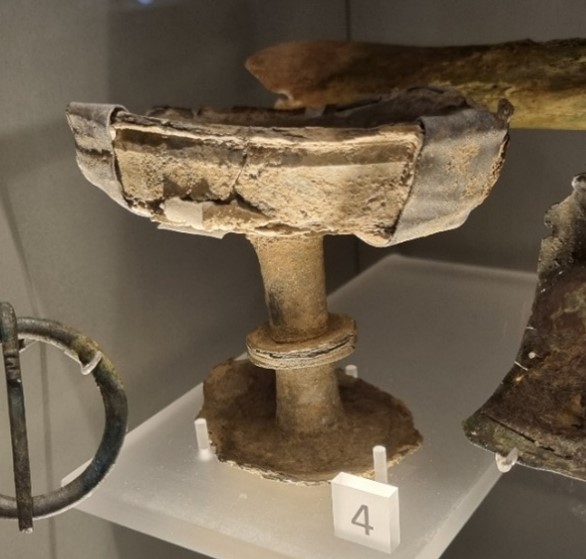
This chalice was discovered in a cemetery located in a small meadow opposite the King’s Road, close to the Jack-of-Both-Sides Inn in Reading. It was found in the hand of a middle-aged man, one of 51 skeletons buried there. Not many people were buried with personal items (often referred to as grave goods) after the eighth century. And, given what we know about the use of pewter chalices, it is believed that this man may have been a priest.
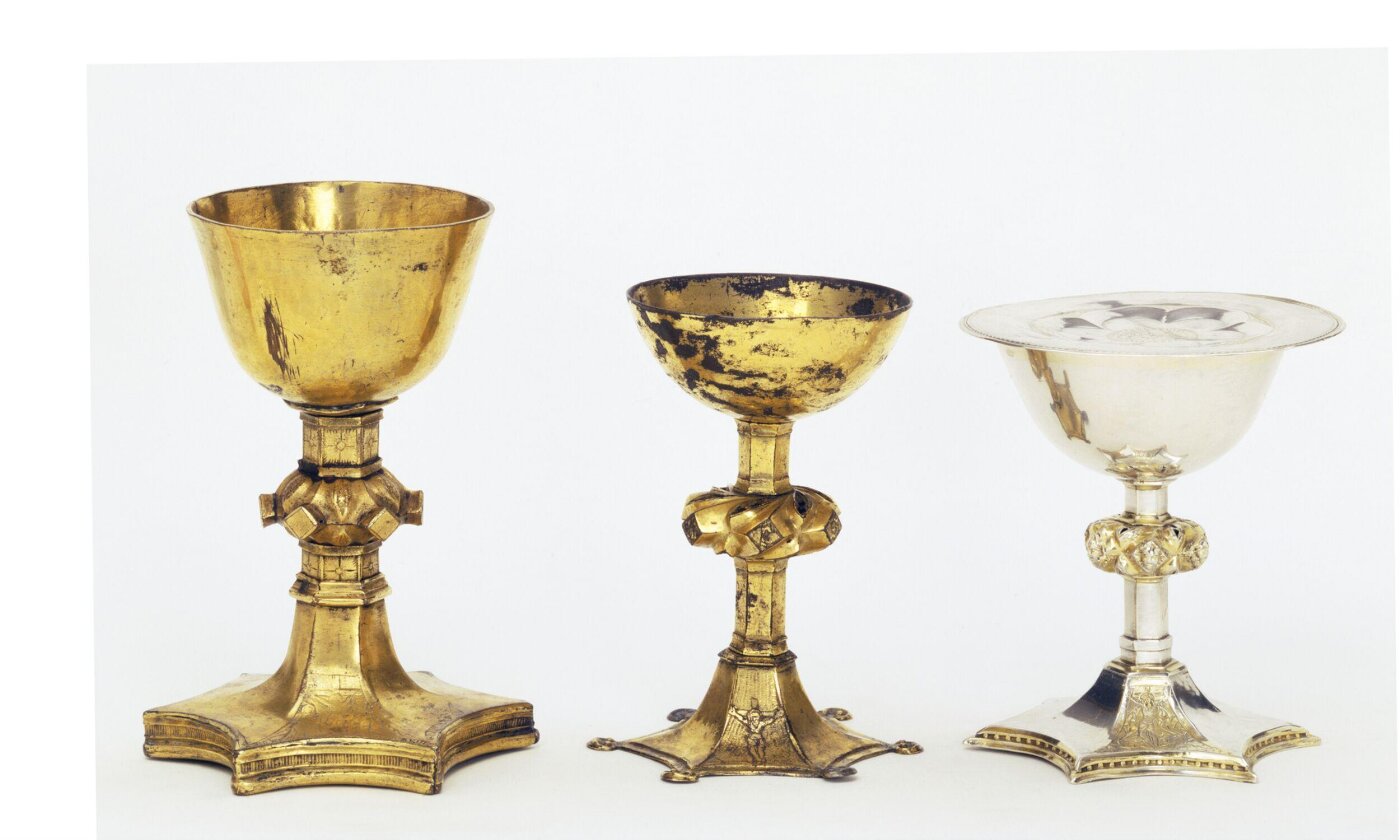
Grave goods were mostly reserved for notable figures but as can be expected, higher ranking church officials like archbishops were buried with more elaborate objects. Archbishops Walter de Gray (1216-55) and Godfrey de Ludham (1258-65) for example, were both found buried with silver-gilt (silver coated with a thin layer of gold) chalices and patens. Bishops and archbishops, and sometimes royalty too, were also buried in full ceremonial robes. The chalices buried with these prominent religious figures would have looked something like the ones shown below. With a hexagonal stem and six-pointed base, these were typical of thousands of chalices used for Mass in Medieval England.
The chalice we are looking at is much more like the one below. This was made in France around 1300-1350 and was found in the tomb of Etienne Bourgeois, Abbot of St. Vanne, who died in 1452. It is also made from pewter (though this one has fared a little better over the years than the Reading chalice!) and shares a similarly plain design. A brief comparison with the silver chalice makes it clear that these objects took various forms, some more ornate than others. So why choose to investigate the more modest of the two?
This is a question Joseph Stevens, appointed the first Honorary Curator of Reading Museum in 1884, asked too. Though he enjoyed a long career in medicine, his personal interest in archaeology foiled any plans for a quiet retirement. He undertook two major excavations during his second career – for those familiar with Reading today, these were located near Gas Works Road and Cemetery Junction. He recorded all his finds in a diary he kept from 1883 to 1898, before gifting these objects to Reading Museum.

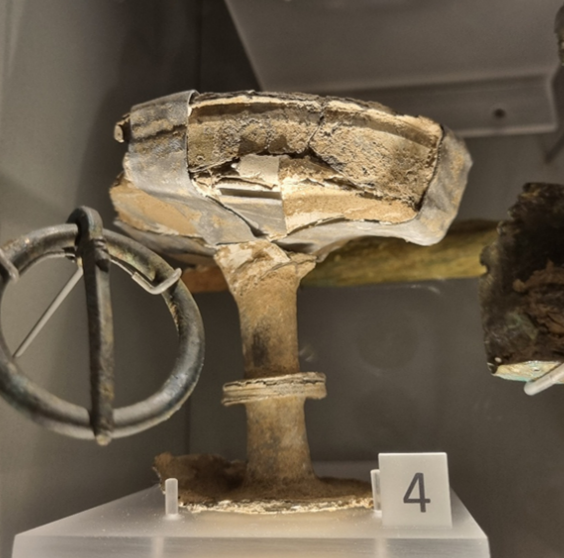
When the curator excavated this chalice at the Cemetery Junction site in 1890, it had disintegrated during its time underground, necessitating some restoration work. Looking from beneath you can see several lighter-coloured strips which hold the chalice’s bowl together. Thanks to Stevens’ passion for conservation, museum visitors can view the object closer to its intended form – though drinking from it is still not advised!
Stevens also valued social history (the study of common people) as well as the power of museums to educate its visitors about local-oriented history. Today, this chalice displays local life in medieval Reading alongside other curiously commonplace objects. These are items which the majority of medieval people would have interacted with in some way. Though we are separated from this chalice by several hundred years (and a glass display case), museum visitors can envision themselves partaking in the practices associated with it and believing in its symbolism. It may not be the most glamorous chalice – certainly, it is no Holy Grail – but as a window into the everyday, it may capture the imagination of local people. You could say that by selecting this chalice for display in the Story of Reading Gallery, Reading Museum has chosen wisely.


You must be logged in to post a comment.