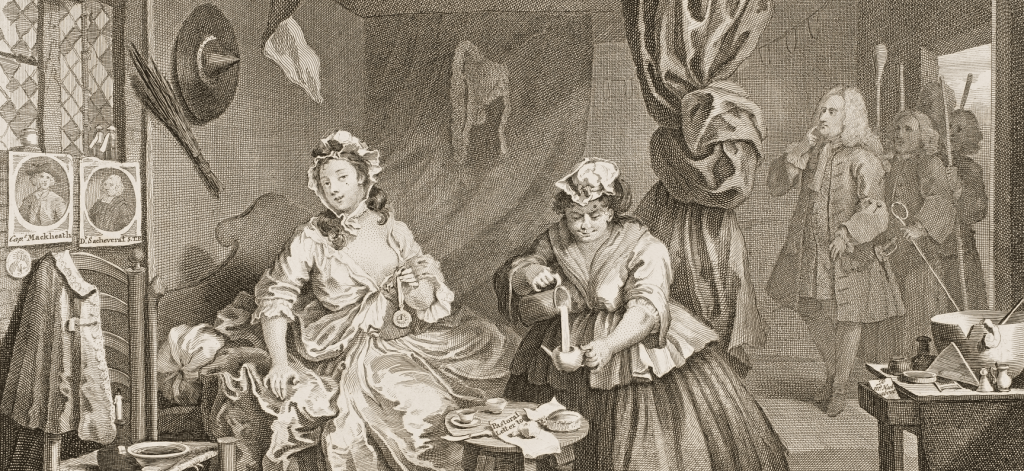
In this post, Part 2 History student Alyssa Parker Harwin shares some of her research into the history of sex work.
March is Women’s History Month in the United Kingdom, a month in which we honour the women in the past who helped pave the way for women in the present. It is essential to not let the women who dedicated their lives to furthering gender equality be forgotten, as without them we wouldn’t have the same freedoms we have today. While we celebrate women such as Ada Lovelace, who created the first ever computer programme, and Dr Shirley Ann Jackson, who made technologies like fibre optic cables possible with her research, it is important that we do not forget the women lost in history. Celebrating women who contributed towards the society we live in today is an essential part of Women’s History Month, however we must also commemorate the ordinary woman, the women who lived lives just like us, and do not have legacies dictated in history books. Taboo topics such as sexual liberation are not clouded by the same stigma they once were, and we must pay homage to all women, regardless of occupation or status.
Fallen woman, courtesan, jezebel and harlot are all derogatory terms that, throughout history, have been used to describe a woman who engages in sexual activity in return for payment, or women who engage in relations with married men. William Shakespeare, praised as the most famous British playwright, often included infidelity within his plays, with the women involved becoming a laughingstock and an easy target for insults. A notable example of this is in Shakespeare’s Henry IV, with the character of ‘Doll Tearsheet’ being a prostitute and providing comic relief within the play. Not only does Tearsheet bring humour to the play through her persistent intoxicated state and sharp comments, but her exit demonstrates the lack of respect people had for sex workers. Tearsheet is arrested on murder charges and is threatened with the punishment of a whipping, her claims of being pregnant quickly shot down by the officers. Tearsheet is just one example of women in Shakespearean plays that are used as comedic relief, but the laughs are at their expense. Sex workers in the late sixteenth-century were not treated as respectable citizens, instead, they were viewed as a tool for humour and mockery.
Centuries later the infamous serial killer named ‘Jack the Ripper’ crawled the streets of Whitechapel, London murdering women, some of whom worked as prostitutes. During the late nineteenth-century England faced what is now named the ‘long depression’ – a period of recession and financial difficulty. The East End of London struggled under the shift from agricultural work to the new industrial revolution, in addition to the rapid increase in population. As a result, many women became sex workers due to the high population and low levels of employment available to women from a working class; two of the ‘Ripper’s’ victims, Elizabeth Stride and Mary Ann Nichols, were sex workers. These women were preyed on and targeted due to the vulnerable nature of their job, and even the victims who did not work in prostitution had their legacy set in stone by the press as prostitutes murdered by an individual whose name is shown across the world, while their names slowly fade into the background. These victims, these women became disposable due to their work.
Whilst many sex workers were put at risk because of their jobs, others were able to use sex work to acquire wealth and independence. For example, Laura Bell became a known figure in nineteenth century England, earning the title of the ‘Queen of London Whoredom’. While this derogatory title suggests Bell’s experience was a negative one, she used her sexuality to gain status and wealth throughout her lifetime. Born in Ireland, Laura Bell took up employment in Belfast whilst engaging in sex work at the same time. With clients such as Oscar Wilde’s father and the Nepalese Prime Minister, Jung Bahadur, Bell received grand gifts and large sums of money in exchange for her services. After retiring from this line of work, Bell became an evangelical preacher and often advised the upper classes to donate money to prostitutes. Fortunately, Laura Bell’s life proves as a hopeful example of a prostitute who exploited society’s judgement to enrich herself.
This year’s Women’s History Month should continue to be a month of remembrance for all the brave women who came before us, even those who history wanted us to forget. Instead of celebrating women individually, and focusing on specific examples, we should strive to acknowledge women as a community who gave so much to allow us modern women the liberties and luxuries we have today.
References:
Begg, P., Bennett, J., Jack the Ripper: the Forgotten Victims (London, 2013).
Ferry, G., ‘Ada Lovelace: in search of “a calculus of the nervous system”’, The Lancet, 386:10005 (2015), p.1731.
Shakespeare, W., Henry IV, Part 2 (Oxford, 2002).
Slaughter, J. B., Tao, Yu., Pearson, W. Jr., Changing the Face of Engineering: The African American Experience (Maryland, 2015).
Titley, N., ‘Laura Bell: Prostitution and Politics’, Camden New Journal (16 May 2019).
Walkowitz, J. R., Prostitution and Victorian Society: Women, Class and the State (Cambridge, 1980).

 READING HISTORY