As part of the second year Going Public (HS2GPP) module, groups of students bid to undertake projects on aspects of public history. In this blog, second year history student Kris Pickett explains why his group chose the ‘Celebrating a Century of Working-Class Students at the University of Reading’ project, and introduces us to the online resource they created.
There were seven different Going Public projects to choose from, but our group was immediately drawn to the one which focussed on the lives and experiences of working-class staff and students across the first 100 years of the University of Reading. As history students, we find looking at people’s lives and how they have changed (or not) very interesting, and as many of our group are working-class students themselves, we wanted to know more about those who came before us.
In researching the project, we had access to archival sources, held at the University’s Special Collections, and we also benefitted from a cache of interviews that the PhD student Sharla Attala had collated for the broader Centenary ‘Celebrating Class’ project. Taken together, these allowed us to look at a number of different areas in relation to the lives of working-class students and how class identity changed over time.
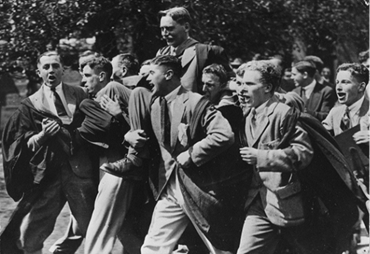
Through first person accounts of working-class students and staff, we could see how people’s views of their own class shifted, seeing it as either what lay behind them (due to the social mobility that university promotes) or what made them who they were. This was interesting to discover, as the understanding of working-class lives often focuses on monetary struggles, whereas the people interviewed focused much more on how ideas about class affected them.
As interesting as it was to learn from the interviews and the sources we could find, there were many issues in finding a wide variety of sources on the lives of working-class individuals, who often left only traces of their presence. This meant that our online exhibition, ‘An Extension College with the Best Intention’, was less comprehensive than we would have liked. Nonetheless, we were able to tell stories that had previously been untold.
The sub-title of the Going Public module is ‘Presenting the Past, Planning the Future’, and we felt that our project is looking to the future in two important ways.
First, many interviewees explained that being asked to talk about their class background was a new experience, and they were pleased to have that background acknowledged by someone at the university. Being able to discuss their experiences and feel comfortable expressing the identities and the cultures that come from being working class is such an important factor in how well people do at university, that this is something we feel it is incredibly important to build on.
Second, although our project grew out of the University’s Centenary celebrations, we feel that it highlighted the need to focus on the experiences of current working-class students today. That is why our website has a section that aims to encourage more participation and the sharing of current students’ (and staff) experiences of being working-class at university. This, we hope, will help to improve student wellbeing and their studies.
Kris was working with Alisha Zubair, Connor Garner, Emily Harris, Evie Woods, Harry Garden, Kat Cholidi, Noah Cahill an Rebeka Negache, and they were supervised by Dr Katie Phillips.
The group’s online resource, An Extension College with the Best Intention, can be found here: An Extension College with the Best Intention

 READING HISTORY
You must be logged in to post a comment.