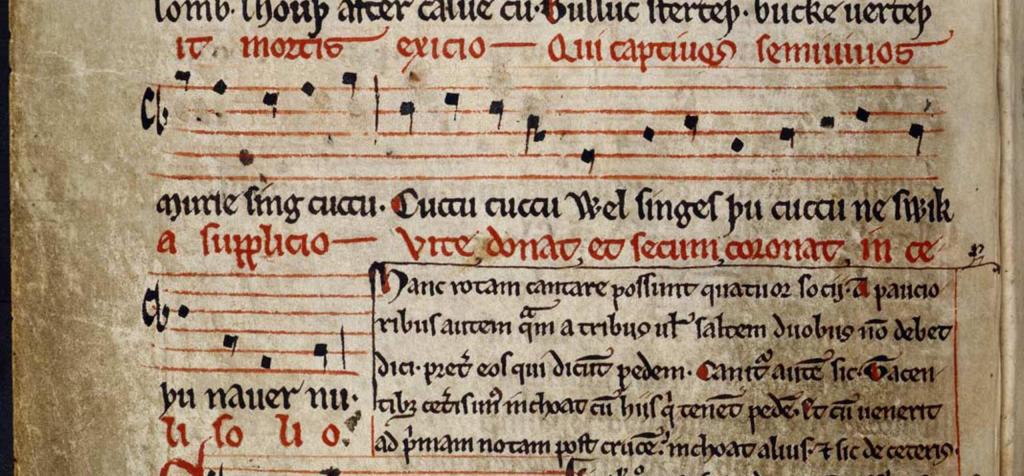
Reading Abbey was founded by King Henry I (son of William the Conqueror) in 1121 and was given wealth and resources suitable for a royal abbey. Successive rulers of England visited the abbey and made use of it to hold major events such as meetings of parliament. The abbey developed close links with the expanding university at Oxford and sent monks to study there, and to return with books for the monastic library. Visitors and pilgrims came to pay their respects to the abbey’s famous relic, the hand of St James. Many of these characteristics of Reading Abbey can be traced in the manuscript containing the song, ‘Sumer Is Icumen In’. This once belonged to the abbey, as shown by its records of medieval abbots.
The manuscript is now held by the British Library, but is currently on display in Reading Museum, thanks to a temporary loan (until 9 May). It is worth seeing, not only as a memorial to the abbey but also as evidence of the development of English polyphonic music, fashionable dance tunes, political poetry, and even medically-related forms of divination and prognostication. Perhaps as significant as the music in this manuscript are its unique collections of both satirical poetry and the works of the twelfth-century author, Marie de France. Marie was the earliest woman to achieve fame as a professional writer of French fables and romances, and the Reading manuscript contains one of the most complete collections of her works.
All this will be explored in detail in the talk to be given by Anne Lawrence-Mathers in Reading Museum on Saturday 2 May – you can sign up here. Meanwhile, Reading Museum is releasing a series of short videos celebrating this important manuscript – together with another, less well-known volume, in the museum’s own collection. The first is below.


